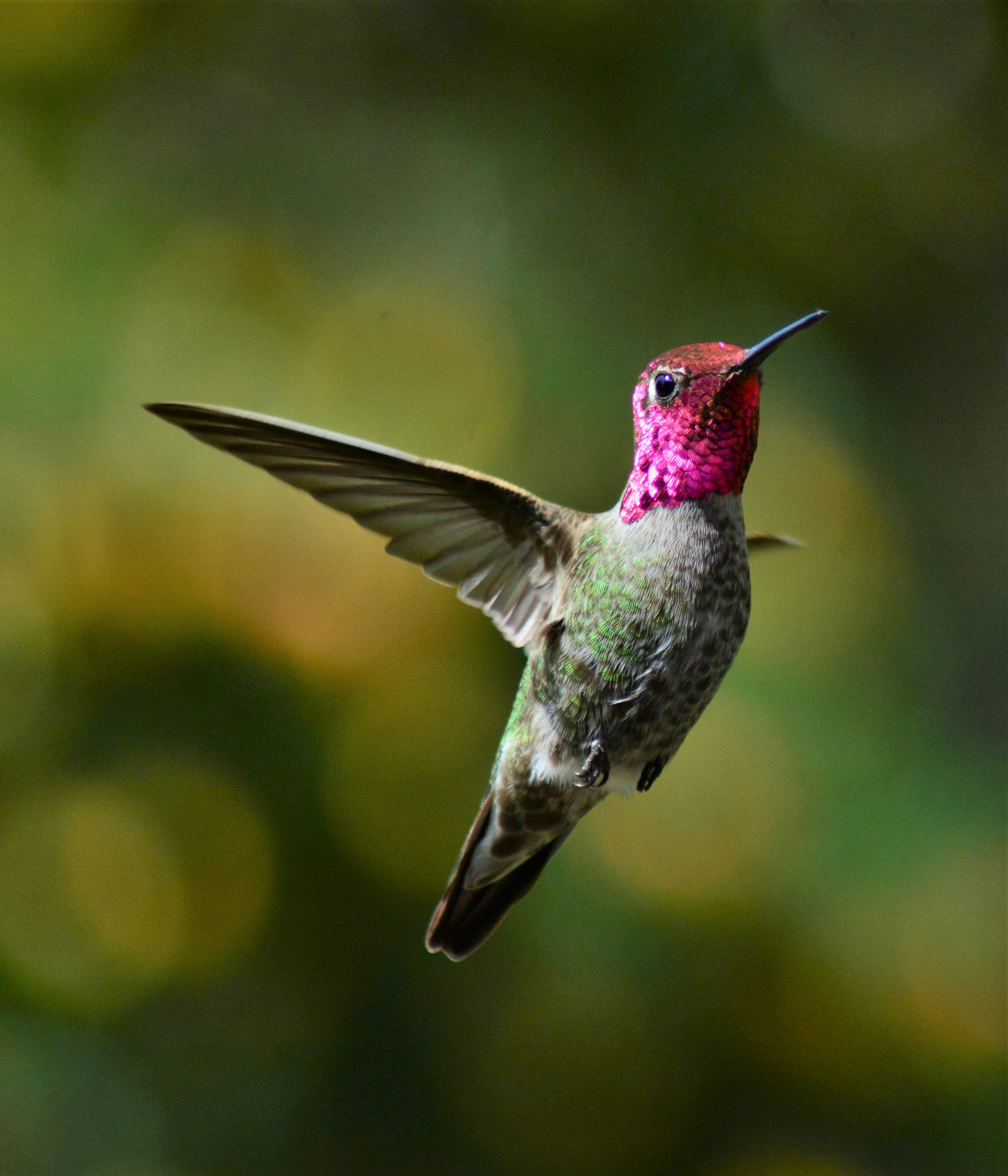
Birds — the tiny hummingbird included — are under-appreciated landscapers. Corvids cultivate oak forests by caching acorns that sometimes take root. Winter flocks of starlings, robins, and waxwings scarify enormous quantities of seeds through their digestive tract. If you’ve ever found a juniper, chokecherry, currant, or invasive buckthorn, especially growing where you wouldn’t expect, chances are good that a songbird’s fertile dropping put it there.
Hummingbirds (family Trochilidae) don’t do any of this. Even so, their effect on our landscapes is equally profound. As we wait for the first trills of male Broad-tails to signal spring in CO, it’s a good time to take stock of the role these tiny, colorful birds play in our lives.
Hummingbirds & Flowers: A love-love relationship
One contribution is obvious: Hummers pollinate flowers. They prefer their blossoms red and tubular. Using long bills and tongues, hummingbirds collect nectar at the bottom of those blooms. The flowers, in turn, dust the birds’ faces with pollen. When the birds hum along to the next bloom, they bring that pollen with them.
Colorado’s most common species, the Broad-tailed, favors several wildflowers that are increasingly common in urban and suburban gardens: Western Red Columbine (Aquilegia elegantula), Scarlet Gilia (Ipomopsis aggregata), penstemons, paintbrushes (Castilleja spp.), and Kingcup Cactus (Echinocereus triglochidiatus). I’ve also observed Broad-tails visiting wild-growing Golden Currants (Ribes aureum) in early spring in metro Denver and Wild Bergamot (Monarda fistulosa) at Roxborough State Park in mid-summer. Black-chinned Hummingbirds, our other common species, browses similar selections of plants.

Visiting flowers is the quintessential image of hummers. No matter that they are also voracious hunters. Hummingbirds catch tiny flying insects almost as effectively as swifts or nightjars (both close relatives of hummingbirds). Besides the garish coloring of the males, I suspect what endears hummingbirds to us is that they visit equally garish flowers. The colors are almost too much! Emerald, ruby and flaming-orange birds meet scarlet blooms. I’ve spent summer hours at the edge of my garden, hoping for one clear photograph that does justice to the intensity of hummingbirds meeting penstemons.
Hummingbird Gardens
Hummers alter landscapes in another way: They use us. Of all the bird families, humans admire them perhaps the most. We can’t move Heaven, but we’ll literally move Earth to attract them into our yards.
In my garden, my preferences track with those of hummingbirds. A single Firecracker Penstemon (Penstemon eatonii) that I planted years ago is now a patch that a male Broad-tailed greedily defends in May. Remarkably, this particular plant blooms with the final May snowstorm of the year. When It bounces back, hummingbirds are all too happy to visit.
Inspired by this bird-blossom interplay, I’ve grown a three-season garden buffet for hummingbirds. In early spring, Golden Currants, Firecracker Penstemon, and Dusky Penstemon (P. whippleanus) bloom in early spring.
Through early and mid-summer, the smorgasbord of native and near-native wildflowers varies wildly. Neighborhood Broad-tails feast on Beardlip Penstemon (P. barbatus), Sunset Crater Penstemon (P. clutei), Nodding Onion (Allium cernuum), Showy Milkweed (Asclepias speciosa), Rocky Mountain Bee Plant (Cleomella serrulate), California Fuchsia (Epilobium canum), Scarlet Gilia, “Red Birds in a Tree” (Scrophularia macrantha), and Desert Willow (Chilopsis linearis).
When summer gives way to autumn, the mint family takes over: Autumn Sage (Salvia greggii), Sunset Hyssop (Agastache ruperistis), and Mosquito Plant (Agastache cana). (Don’t let that last name mislead you. It’s so named for its alleged ability to repel mosquitoes. I find it happier in my Denver than Sunset Hyssop, a plant more commonly sold at nurseries.)

Hummingbirds are Big Business
“Hummingbird-friendly” plants are big business for wildflower nurseries. Major retailers of regional natives and/or xeric plants grow heaps of them. The Plant Select nonprofit collaboration classifies more than two dozen of its selections as hummingbird-friendly. Prairie Moon Nursery lists 56 plants and seeds packs for hummingbirds. High Country Gardens offers an astonishing 186. Most seed providers curate mixes said to attract hummingbirds. Locally, Botanical Interests of Broomfield, Colorado, has its “Hummingbird Haven” mix, as does BBB Seed of Boulder.
We haven’t just remade the landscape in service of hummers. We’ve also redecorated it. Feeders are outdoor décor du jour. There are really only two ways to fashion hummingbird feeders: as saucers, with the sugar-water in a flat dish within perching and feeding reach, and as inverted-bottle feeders, with a container of sugar-water above the feeding area.
But discerning birdwatchers can choose from all sorts of designs. Hummer feeders today come in clear glass, ornate blown glass, orbs, wine bottles, antique red bottles, and red plastic. There are feeder rings and even hummingbird feeder masks you can wear for the ultimate close-up view. The choices seem almost as numerous as hummingbird species themselves. (There are 363 kinds of hummingbirds, one of the bird world’s most diverse families.)

Hummer feeders as we know them date to the late 1920s and early 1930s. But even before that, people fed them simply by pouring sugar-water into a dish. The first may have been someone’s last-ditch effort to nurse a bird accidentally trapped indoors and exhausted trying to escape. An 1885 article in the ornithological journal The Auk recounted how a clever woman in Wisconsin nourished a Ruby-throated Hummingbird for almost two months. First she tried pouring sugar-water mixtures into the flowers of a gladiolus. Then she hung a vial of the nectar amid petunia blooms.
Others who fed hummingbirds were more daring. In the 1907 edition of his field guide, Handbook of Birds of Eastern North America, ornithologist Frank Chapman wrote: “The Hummingbird is curiously fearless. Sometimes one will probe a flower in the hand and when they fly into houses, as they pretty often do, they manifest but the smallest degree of suspicion and will feed at once upon sugar held between the lips.”
Too much of a good thing?
There are other, more profound relationships between hummingbirds and us. Most obvious, perhaps, is that we use some of the same plants for food. For the birds, it’s the nectar. For us, it’s the fruit that their pollination produces. Hummers are especially important pollinators of currants and blueberries, both valuable to humans. They also have mythic and literal associations with tobacco plants, especially in indigenous peoples’ beliefs in the Americas.
And then there’s this: By using our landscapes to attract hummers, we’re actually altering their behavior and ranges. A 2019 study documented the expansion of the range of Anna’s Hummingbird from the Baja Peninsula north into colder locations with higher densities of people’s homes. Using Project FeederWatch data, the study’s authors also found the species was more likely to visit feeders in there than in its historical range. The appearance of Anna’s farther north may have led to changes in human behavior, too. More people in the bird’s new northerly range were putting up feeders to attract the species, which was not the case in its historical range.

At first glance, this all seems good news. In a time of declining bird populations, isn’t a greater range for Anna’s Hummingbirds a welcome development? The authors aren’t sure. They write that “long-term ecological consequences of the . . . range expansion remain uncertain.” Of note is that the species is moving into the historical range of Black-chinned and Rufous hummingbirds. As anyone who’s watched hummers know, species competition is fierce for territories and food. How the arrival of Anna’s will affect Black-chinned and Rufous populations remains to be seen.
Here in Colorado, the range of Black-chinned Hummingbirds has crept east and northeast over the past 40 years. The cause is not yet clear. Territorial competition in their historical range, climate warming, warmed micro-climates (e.g., the urban heat island), altered landscapes, and feeders all may be leading Black-chinned hummingbirds east.
Whatever the reasons, this much is certain: It’s a hummingbird’s world, and we’re just living in it.

___________________________
A Note on Hummingbird Gardening
Take care with plants and seeds labeled for hummers, as many are introduced species. I especially hesitate to recommend BBB Seed’s “Wildflowers to Attract Hummingbirds” mix, though I like many of BBB’s individual seed packs. That particular mix contains Rocket Larkspur, which is quite weedy, and all parts of the plant are highly toxic. Of the other retailers I listed in this essay, only Prairie Moon exclusively sells plants and seeds native to the US. However, all have extensive selections of native and near native plants. For more information on gardening with CO native wildflowers, see the guides provided by Wild Ones Front Range or Rocky Mountain Audubon.
This essay originally appeared in the April 2025 issue of Denver Field Ornithologist’s The Lark Bunting. Thanks to Pat O’Driscoll for editing this essay.
Leave a Reply