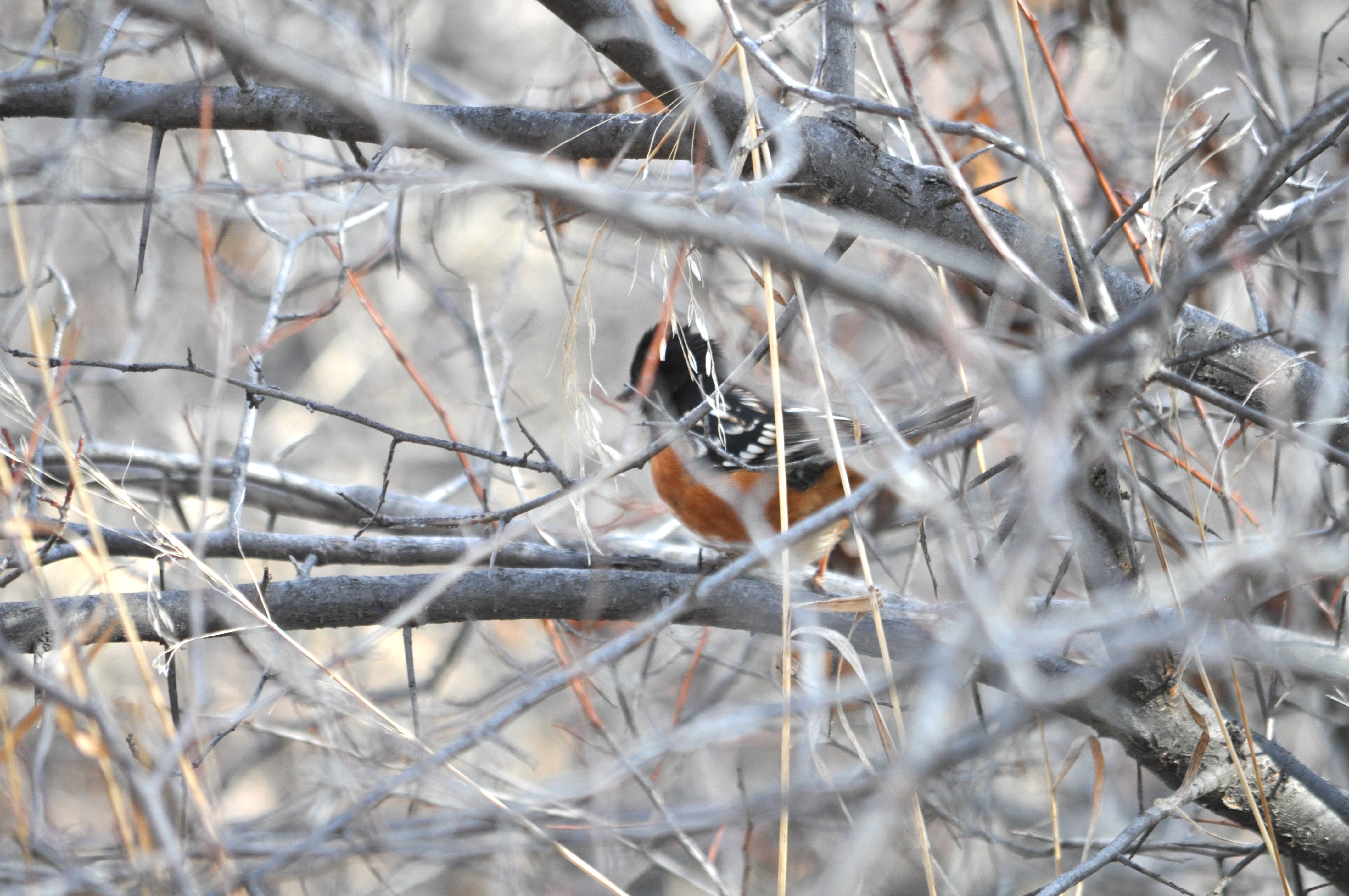
Since moving to the southern suburbs of Denver in 2016, I’ve held my own informal winter bird count in my local birding patch. Wedged between Denver’s two Christmas Bird Count circles, my local patch is a mix of suburban parks, a few with ponds; thin, riparian corridors along creeks you can hop over; and humble open spaces.
This year’s count had me crossing paths with 45 species. Among the birds, highlights included a White-throated Sparrow and a Hermit Thrush. Neither is unexpected in the winter around here. But neither is exactly commonly encountered. A Merlin, American Kestrel, and Bald Eagle joined the more common Red-tails, Cooper’s Hawks, and Eastern Screech-Owls to make it a rather raptor-rich outing.
All told, the mix of species I encountered was fairly typical for winter. And, so, other encounters stood out.
Western Honey Bee Colony
Apparently displaced by recent tree work, a colony of Western Honey Bees attended to honeycombs in the cold.

Western Honey Bees (Apis mellifera) are an introduced species in the US. In the Denver area, they can often be found in the enormous cavities of old cottonwoods. They also collect cottonwood resins for its anti-microbial properties.
The High Line Canal’s century-old cottonwoods are intensely managed. The trees’ enormous branches and trunks often fall, usually directly on heavily trafficked trails. Unfortunately, this means losing — at least temporarily — some prime habitat for Screech-Owls and other cavity-nesting species. Indeed, near this honey bee colony was a perch favored by a Screech-Owl that is now conspicuous in its absence.

Happily, an owl was still around here. I briefly got good looks at one perched over the Canal. And luckily, there’s a plan to rebuild the Canal’s tree canopy. Still, the loss of old, rotten, hole-y cottonwoods may mean changes for the area’s cavity-nesters.
Mosses!
More and more, my outings have me looking for mosses. No easy task. Denver is sun-soaked and semi-arid. Mosses only seem to thrive here in damp edges of irrigated lawns, the base of landscaping trees, and, ever so occasionally, on north-ish facing rocks or mortar.
A furry rock moss, amid lichens graffiting a concrete slab at a local open space, was a fun discovery–even though it’s far less photogenic than its remarkable neighbors. Likely in the family Grimmiaceae, the moss isn’t showing its good side, as it’s fairly dry and curled in on itself.


Remains of a Hawk
Near the end of my walk, I cut through a roadside field to look at a pine tree. I’m not sure why the tree called to me. But beneath it were the remains of a hawk — a Cooper’s or Sharp-shinned. Tail feathers caught my attention first, and I eventually spotted completely bare bones, including the skull.
Photos below.
A note on the ground beneath pines and other conifers: at least in the Denver metro area, these are almost always worth inspecting (if you’re comfortable finding evidence of hunts). I started looking beneath them in hopes of finding owl pellets. I’ve not yet succeeded at that, but I’ve learned that conifers provide good coverage for predators. It’s beneath them that I’ve found the remains of rabbits, a Great-horned Owl, and now this hawk.



Leave a Reply