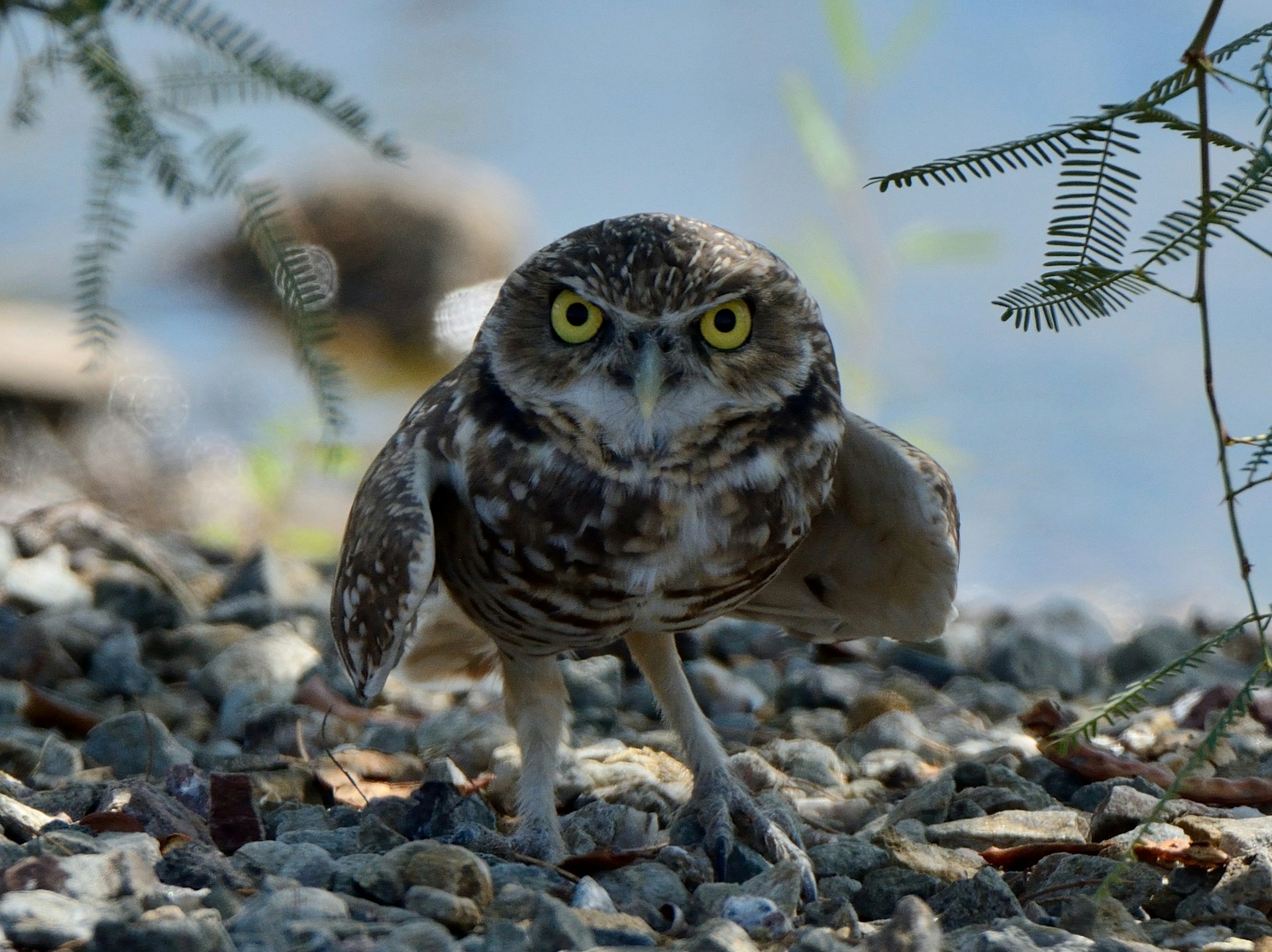
Survey 100 people, in the style of TV’s “Family Feud,” about the places where birds nest. Tally their answers, and I’ll bet “UNDERGROUND” wouldn’t crack the top five responses. Probably no one but a birder would think to mention this rather odd nesting habit for some feathered creatures that fly.
Here in Colorado, we know better. Exhibit A is the Burrowing Owl, one of our most photogenic and photographed owl species. But don’t let the name mislead you. Burrowing Owls may nest below ground, but in the plains, deserts and basins of the West they rarely excavate their own subterranean homes. Like seasonal renters, they move into burrows previously dug by mammals. (Airbnb on the prairie!) Come to think of it, “Burrow Owl” would be more accurate.
Prairie dogs are the best-known providers of the birds’ temporary digs, but Burrowing Owls also use the holes of ground squirrels, badgers, skunks, marmots, armadillos, kangaroo rats, and even tortoises. Not having to dig allows them to focus on furnishing their nests, and they do so in another odd but purposeful way. Burrowing Owls feather the beds of their nests not with feathers but with dried livestock manure. This “bedding” is thought to have a double and perhaps even triple purpose. It attracts insects that the owls hunt and eat, and it signals to other owls that a burrow is occupied. It may even mask the owls’ smell from predators.

Although Burrowing Owls may be Colorado’s only truly subterranean nesters, a host of other familiar bird species nest in deep holes and earthen cavities that are certainly “under ground” if not actually underground. Belted Kingfishers are one of our most common and widespread tunnel nesters. They tend to dig their own into earthen banks near water. Where I bird in the southern suburbs of Denver, this usually means in the soil banks of small creeks. Both females and males excavate their nesting holes, digging with those stout, pointed bills. They also kick the dirt out of the tunnel with feet whose fused outer two toes may help make the digging easier. The job typically takes 3 to 7 days for a 3- to 6-foot tunnel that dead-ends in a nesting chamber.
Belted Kingfishers don’t build nests, per se, in these chambers. The Cornell Lab’s Birds of the World notes that during incubation, “regurgitated pellets . . . of undigested fish bones and scales and chitinous exoskeletons of arthropods may accumulate, forming a somewhat insulative layer between eggs” and the chamber’s bare floor. (A Burrowing Owl’s dried-manure bedding doesn’t sound so bad by comparison, does it?)
Like Belted Kingfishers, aptly named Bank Swallows also dig their own burrows — in colonies of individual 5-foot horizontal shafts into riverbanks, cliffs and bluffs near water. These little birds throw their whole bodies into the effort. “Dislodged material. . . is ejected with vigorous kicks and wriggling body and wing shuffling movements,” Birds of the World tells us. Males start the digging. Once a female chooses a mate and his nest site, they share the work.

Although I rarely encounter Bank Swallows in the southern suburbs, another tunnel-nester is more common: Northern Rough-winged Swallow. Kingfishers and Northern Rough-wings share habitat in Centennial and are fairly common along its creeks and canals. This is no accident. Like Burrowing Owls, the swallows often reuse the burrows of other animals, including kingfishers (and even Bank Swallows). Unlike the sparely furnished holes of those two species, the “proper” nests of Rough-winged Swallows contain twigs, stems, grasses, conifer needles, mosses, mud, dung, and, as the poets of Birds of the World put it, “miscellaneous bits of rubbish.”
More varied is the nesting of our two most common swallows, Cliff and Barn. Natural nest sites for both species include caves, though Barn Swallows today use such sites infrequently now. Both also favor edges and covered locations on human structures. You can find Cliff Swallow nests under busy overpasses and near the top of shopping center facades. Barn Swallow nests can be just above eye level on storefronts, but also in the almost-underground entrances to underground parking garages at large shopping centers. The latter sites cater to birds and birders alike. I have watched Barn Swallows hunting insects around garage lights well past sunset, a diurnal species taking advantage of artificial “day.”
Chickadees nest in cavities, almost exclusively above ground. But three years ago this July, DFO birders on a trip led by David Suddjian found a Mountain Chickadee nesting in a rotted stump only 3-4 inches above ground level. Ever the careful observer, Suddjian returned the next day to investigate this unusual choice of chickadee nest site. He reported the following on his eBird checklist:
“The adult approached from a nearby pine trunk or nearby Douglas-fir foliage. From those points it flew directly down to the cavity in the ground and disappeared. It soon emerged at the usual short interval for feeding nestlings, and without food, but the young could not be heard. Upon exiting the adult would pause for a moment on the stump at ground level and then fly up and off.” The same goes for some Black-capped Chickadees, who are known to nest in cavities at “ground level,” Birds of the World confirms.
Although not quite birds of the underworld, wrens are so well known for nesting in cavities and foraging in dark edges, holes, and crevices that science named their family Troglodytidae, or “cave-dweller.” The genus name for the common and widespread Northern House Wren shares these Latin roots, though the lifestyles of Rock and Canyon wrens are more deserving of the cave-dweller label. House Wrens only occasionally nest in cave-like openings, while Rocks and Canyons typically nest in crevices and ledges. Like Burrowing Owls, some Rock Wrens may nest in rodent burrows, too, though the ornithological record is spotty at best.

What is clear is that Rock Wrens alone, not Burrowing Owls or kingfishers, often enhance their nest sites in crevices or holes in an unusual way: “Paving” the nest and a “stone patio” leading into it with flat rocks! A 2015 study of Rock Wren nests in northern Colorado showed that these stone “pavers” have important structural effects. They protect nests from rainfall, and they amplify the noise of approaching predators. (They also may help regulate and retain heat in the nests.)
For good enough reasons, birding organizations will probably never host a field trip to a parking garage, creek bank, rodent tunnel or other underworlds in search of the clever species that nest somewhere within them. But we could do worse than look for birds ourselves in these unexpected yet still essential habitats.
Featured Photo by Alex Makarov on Unsplash
Leave a Reply