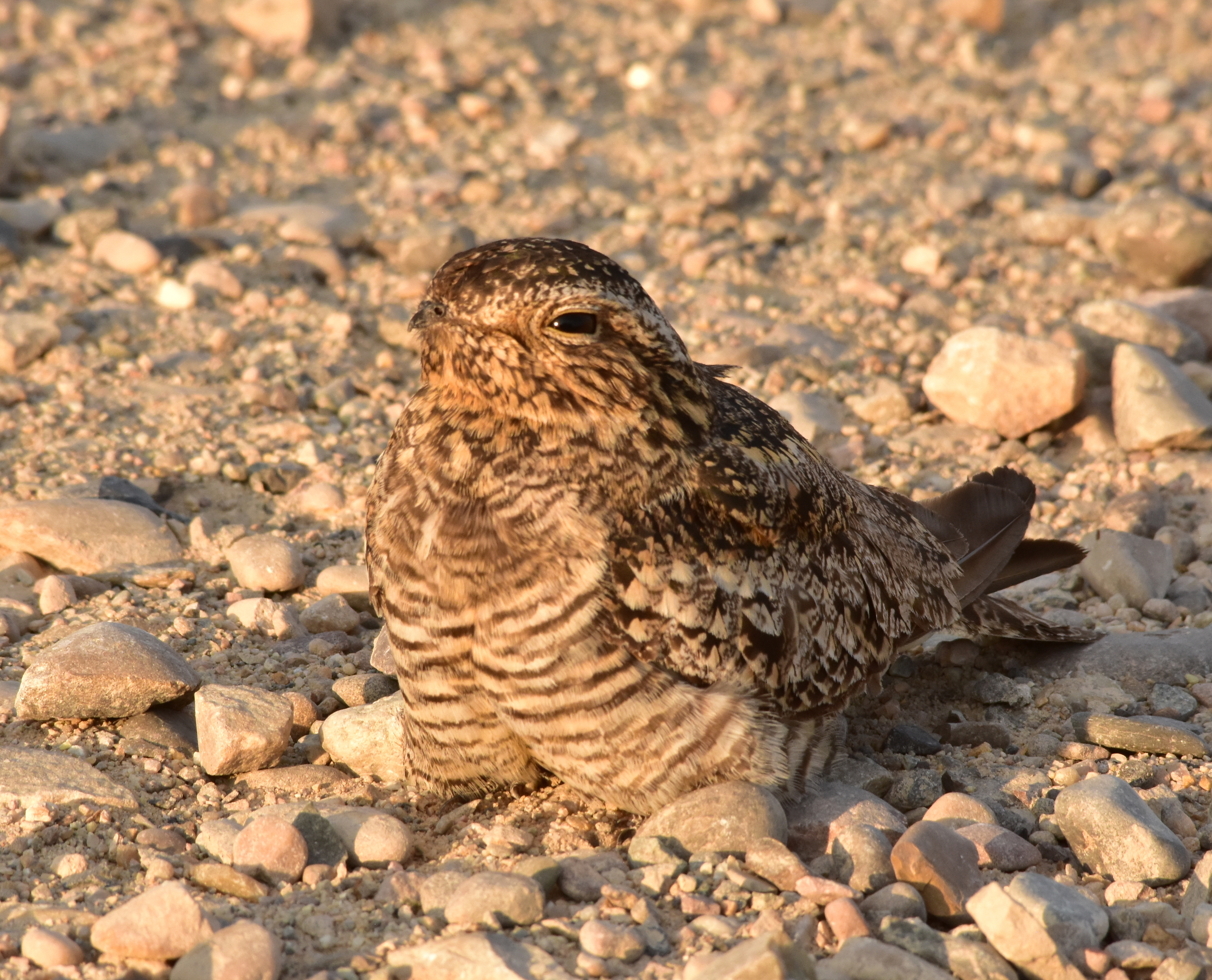
On Wednesday, June 1, 1853, Henry David Thoreau stumbled upon a nesting Common Nighthawk. He visited the nesting site the following Tuesday. There, he found the mother Nighthawk dutifully brooding her two eggs.
The bird clearly impressed Thoreau. Much of his entry is given over the bird’s appearance on her nest — still and stoic, as if “a figure in stone or bronze.”
Thoreau was especially taken by the nighthawk’s ability to move between absolute stillness and motion. Through cold spring rains, the nighthawk “sits motionless on its eggs on the barest, most exposed hills, through pelting storms of rain or hail , as if it were a rock or a part of the earth itself.” But as soon as she needs, she unfolds into flight, “one of the most aerial , supple, and graceful of creatures, without stiffness in its wings or joints.”

From bird to stone: Nightjar camouflage is a key to survival
Common Nighthawks are members of the Nightjar family (Caprimulgidae, or the Goat Milkers). It’s a remarkable group of birds, fitted to the extremes of life — whether the temperature extremes (looking at you, Common Poorwill) or those of stillness.
Most nightjars, including Common Nighthawks, nest directly on the ground. During the long summer days, the camouflage of their feathering and their unnatural stillness is their primary defense against predators.

Nightjar plumage is indeed as miraculous as Thoreau seemed to believe. D. T. Holyoak, in his encyclopedic Nightjars and their Allies, works the edges of the English language to characterize it. Nightjar plumage is “vermiculated” — “marked with irregular fine lines or with wavy impressed lines” — tells us. This is a rare word indeed, which carry all sorts of other meanings that might aptly describe nightjar camouflage — “worm-eaten,” “tortuous.”
Nightjar plumage allows them to disappear into the habitats where they nest. Whip-poor-wills are warm browns and oranges, the better to mimic the rotting leaves and wood of the eastern forests where they breed. Common Poorwills are silvery grays of stone and flaked bark.
Even seen close up, nightjars look more like debris than a bird. Their patterning “obliterates,” as Holyoak puts it, their outline. The eye doesn’t know where to settle.

June 7, 1853, Thoreau visits the Nighthawk Nest
June 7, 1853. Visited my nighthawk on her nest. Could hardly believe my eyes when I stood within seven feet and beheld her sitting on her eggs, her head to me. She looked so Saturnian , so one with the earth, so sphinx-like, a relic of the reign of Saturn which Jupiter did not destroy , a riddle that might well cause a man to go dash his head against a stone. It was not an actual living creature, far less a winged creature of the air, but a figure in stone or bronze, a fanciful production of art, like the gryphon or phoenix. In fact , with its breast toward me, and owing to its color or size no bill perceptible, it looked like the end of a brand , such as are common in a clearing, its breast mottled or alternately waved with dark brown and gray, its flat, grayish, weather-beaten crown , its eyes nearly closed , purposely, lest those bright beads should betray it , with the stony cunning of the Sphinx. A fanciful work in bronze to ornament a mantel. It was enough to fill one with awe.
The sight of this creature sitting on its eggs impressed me with the venerableness of the globe. There was nothing novel about it. All the while, this seemingly sleeping bronze sphinx, as motionless as the earth, was watching me with intense anxiety through those narrow slits in its eyelids. Another step, and it fluttered down the hill close to the ground, with a wabbling motion, as if touching the ground now with the tip of one wing, now with the other, so ten rods to the water, which it skimmed close over a few rods , then rose and soared in the air above me.
Wonderful creature, which sits motionless on its eggs on the barest, most exposed hills, through pelting storms of rain or hail, as if it were a rock or a part of the earth itself, the outside of the globe, with its eyes shut and its wings folded, and, after the two days ‘ storm, when you think it has become a fit symbol of the rheumatism, it suddenly rises into the air a bird, one of the most aerial , supple, and graceful of creatures, without stiffness in its wings or joints!
Credits
Header Photo by Tom Koerner of USFWS Mountain-Prairie
Excerpt from Thoreau’s journal from Thoreau’s Bird-lore, edited by Francis H. Allen (1910).

Leave a Reply