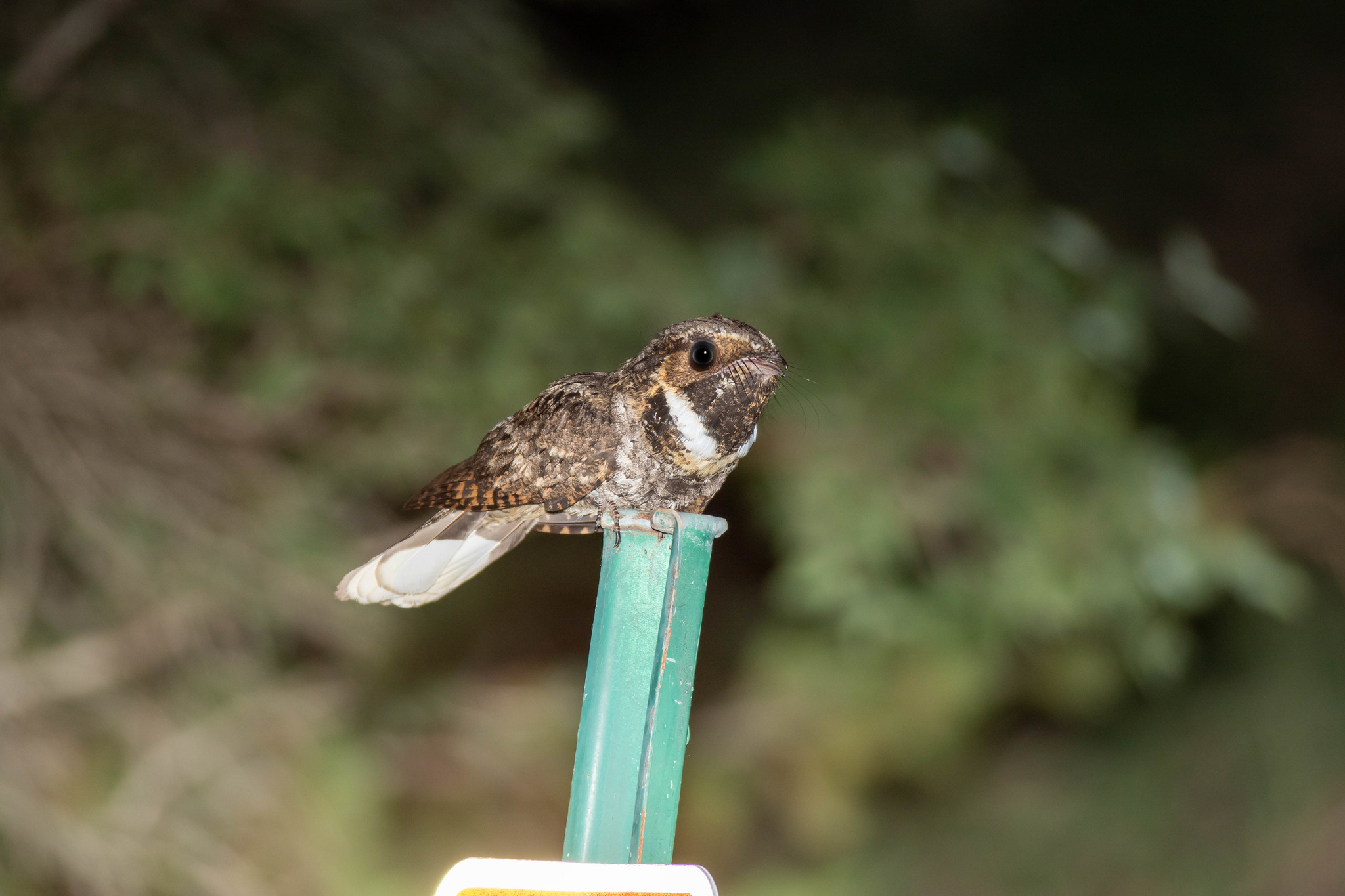
Whip-poor-wills return to their breeding range in the eastern United States in April and May. If you share a range with Whip-poor-wills, you have a really good chance of hearing one in the early spring, when the birds are especially vocal. The days before and after full moons are especially good, as Whip-poor-wills are known to sing more under a lit sky.
Whip-poor-will, like many other nightjars, tend to sing most vigorously during the half hour or so after the sunset and before sunrise. I’ve been told that waiting until after nautical twilight ends is your best bet, especially for Common Poorwills in Colorado. I imagine, but I don’t know for a fact, that the same is true for Whip-poor-wills. So if you want to know when to hear them or other nightjars, you can look up when nautical twilight ends where you live here.

But you also want it to be warm. If cold moves in, nightjars are likely to be less active. If you see flying insects as sunset, it’s probably warm enough for Whip-poor-wills.
Where to hear Whip-poor-wills?
Where should you try to hear a Whip-poor-will? eBird can offer you some clues. Just search their species map for places where Eastern Whip-poor-wills have been reported previously.
But if you have your own favorite birding spots or you enjoy the thrill of discovery, here’s what we’re looking for: a woods with open canopies that have a mixture of shrubs and young trees. Woods that are occasionally logged are like this. Woods that are cut to allow train tracks or transmission towers through are like this. Forest that gives way to a rich meadow is like this. In other words, you’re not looking for an endlessly deep forest, as alluring as those are. And, generally, you’re not looking for a forest that only opens at a roadside. You need biodiverse breaks in coverage — young trees and shrubs, especially.

Biologists think that Whip-poor-wills prefer forests with open canopies because it makes hunting easier. Whip-poor-wills tend to hunt from the ground or from low perches. They sally upwards at flying insects. An open canopy means that moonlight breaks through the forest, backlighting prey.
To find Whip-poor-wills, find oaks. And bugs!
Through much of their range, Whip-poor-wills tend to prefer oak-pine forests. Oak leaves decompose slowly, contributing to a rich leaf litter that adult and baby Whip-poor-wills can both disappear into. Oaks are also excellent hosts plants, meaning they provide food that many (many!) larvae of insects, especially butterflies and moths, eat.
And this is important because, for Whip-poor-wills, the buggier the better. A few autumns ago, I went looking for Whip-poor-wills in the Hudson Valley of New York. (I wrote about this experience for Audubon.) Where Whip-poor-wills were, so were moths that rushed my car headlamps and mosquitoes ate me alive. Not exactly pleasant for me, but wonderful for the birds.
Patience is a virtue. Persistence, too.
But keep in mind, that while Whip-poor-wills aren’t rare, they’re only “locally common.” This means they are where they, and they’re not where they’re not. This is different than, say, an eagle or hawk, who flies around and who you have a reasonable chance of seeing near a nest, far from a nest, … really, just about anywhere as they fly between locations.
So expect to be frustrated by the absences of the birds. While trying to hear nightjars or see nighthawks, I’ve not heard them more than I have. The same is true for biologists who survey for them. Unless you’re indeed close to a breeding territory, not hearing a nightjar is more common than hearing on
Safety First–for you and Whip-poor-wills!
Most of my encounters with Whip-poor-wills have been on quiet roadsides. Even so, they’re not devoid of passing traffic. Because it’s night, I try to park on established pull offs. Driving around potential habitat during the day is good for finding these.
I also wear a headlamp so that cars can see me. I prefer those with red light so it is gentler on the eyes of all night species, humans included.
We don’t need playback to hear a Whip-poor-will. If they want to sing, they’ll sing, and we don’t want to give a Whip-poor-will with an established territory any reason to leave it. Plus, if you want an authentic Whip-poor-will experience, of the sort that generations of others have had, you’ll wait for the song, rather than provoke it.
And we don’t need to get closer. So if you’re fortunate to hear a bird sing, just let him sing. After all, this is also how generations of people have experienced Whip-poor-wills: as a sound, a name, a song laden with meaning through spring and summer nights. Plus, if you stay out of Whip-poor-will habitat, you’ll avoid ticks!
Nightjars often hunt on roadsides. So drive slowly and carefully if you’re in Whip-poor-will habitat. Too many of the photos of nightjars on iNaturalist are of dead nightjars: those struck by cars or killed in collisions with urban windows.
And please — if you hear a Whip-poor-will, let me know. I love hearing these stories! You can leave a comment or email me at jared at lonesomewhippoorwill.com
Featured photo by flickr user budgora. Some rights reserved.


Leave a Reply