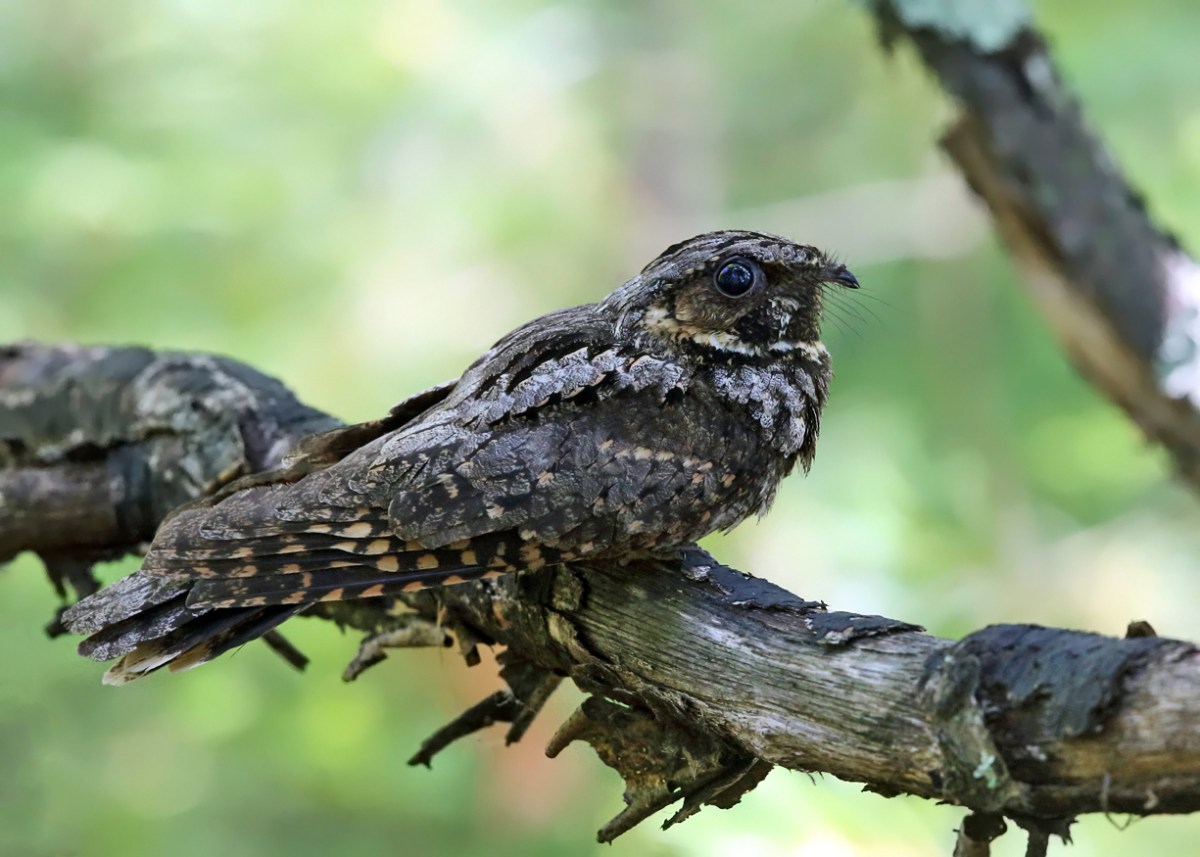
Nightjars both, Eastern Whip-poor-wills and Common Nighthawks have long been confused for each other. Naturalists of the 18th and 19th centuries often combined features of both birds in their paintings and illustrations. So if you’re struggling to figure out whether you saw a Whip-poor-will or a Nighthawk, you’re in good company.
Need proof? Here is a drawing, labeled “Whip-poor-will,” by John James Audubon. With its prominent white-throat, white wing patches, and lack of bristles (or whiskers) around the bill, the drawing more closely matches the Common Nighthawk.

There are several reasons that the two birds might be mistaken for each other. The range of the two species overlaps in the eastern U.S. In most places where you might see a Whip-poor-will, you could also encounter a Common Nighthawk.
The two are also superficially similar in appearance. And because we’re most likely to see both in the lowlight of twilight and night, the differences between the two can be difficult to see.
But there are several key differences that we can use to tell the difference between Eastern Whip-poor-wills and Common Nighthawks. And most of these differences don’t require us to get a good look at the bird in question.
Differences in Vocalizations: Whippoorwills say their Names!
An obvious difference between the two birds is their call. The two birds just don’t sound like each other! Whip-poor-wills offer one of North America’s most famous bird calls. Most of the time, you’ll hear it as a three syllable call of, well…”Whip-poorwill.”
Whip-poor-wills may repeat this call several, dozens, even hundreds of times. You’ll probably not even see a Whip-poor-will as he gives this call.
By comparison, Common Nighthawks aren’t especially musical. Their vocalizations is usually described as a nasal or mechanical call of “peent.” This is sometimes represented as “beer,” and ,though I can here the resemblance, I find “peent” just a bit closer.
Nighthawks often give their call during high flights over their nesting territories. You have a much better chance of spotting a calling Nighthawk than Whip-poor-will. Just look up.
Differences in Behaviors: Nighthawks Flock!
Common Nighthawks are famous for forming large flocks, of hundreds, even thousands, of individual birds. You’re most likely to see a Common Nighthawk flock during fall migration, when the birds move in loose groups from their more northerly breeding grounds to their southern winter homes.
You won’t mistake a flock of Nighthawks for much else. When hunting in flight, the birds furiously pursue insects. They’ll arc in flight, tip backwards, and cut unexpectedly.

But the tell-tale is the white wing bars near the end of those long, pointed wings.
By contrast, you’re unlikely to encounter multiple Whip-poor-wills and especially not in flight. Though it’s possible to hear multiple Whip-poor-wills calling in one location, the species isn’t particularly known for flocking in North America. If you see dozens, even hundreds, large, sharp-winged birds hunting insects at dusk or migrating over waterways, you’re definitely not looking at Whip-poor-wills.
Differences in Habitats: City Birds, Country Birds
Common Nighthawks are a widespread species, ranging from Maine to California. They nest as far south as Central America and far north as northern Canada. Their success is at least in part because they’re generalists, at least by Nightjar standards. They nest in dunes, beaches, cleared forests, prairies, grasslands, and rocky areas. They can even nests in cities on gravel-lined roofs of buildings.
Whip-poor-wills require a more specialized habitat: forests with minimal underbrush.
A Nightjar perched on a wire or fence at the edge of grasslands or encountered in a city is more likely a Common Nighthawk than an Eastern Whip-poor-will.
But care is needed in identifying a Nightjar by location. In the U.S. west, Common Poorwills are regularly spotted in cities, especially during migration. Lesser Nighthawks are also found in urban locations in the southwest. One welcomed me to Tucson this past summer, flying low over my hotel in an industrial area.
Meanwhile, in the southeast, Chuck-will’s-widows can often be heard in more suburban places.
Differences in Plumage: Nighthawks Show Their Spots!
In flight, Common Nighthawks show prominent white throat patches and white wingbars. But even when perched, these are far more noticeable on a Nighthawk than on a Whip-poor-will.
Sure, Whip-poor-wills have a whitish necklace. And they have white feathers in their tails, which they flash during territorial displays.
But when perched, Whip-poor-wills usually position themselves in ways that obscure or minimize their white feathers. For them, invisibility is key, and their conspicuous white feathers are best kept to themselves.

By comparison, Nighthawks are more willing to show out. Here’s a photograph of a perched Nighthawk, on which the white throat is visible. The white wing patches are also visible near the middle of the wings (just to the left of the branch on which the bird is perched.

To my eyes, Whip-poor-wills also have a bit more shaggy and roundish of an appearance than Nighthawks, who appear more sleek and aerodynamic. They live different lives, and their shape shows it.
Differences in Appearance: Whippoorwills have Whiskers!
If you’re lucky enough to spot a Nighthawk or Whip-poor-will during the day, pay attention to the bird’s face. A key difference may be staring you in the face. Whip-poor-wills have prominent bristles, which are feathers that appear like whiskers, around their beaks. These are barely visible on Nighthawks. Heavily cropping the two photos above shows this.

The Other Whip-poor-will
Across the U.S., there are several other related species you could encounter. If you’re in southern Arizona or New Mexico, Mexican Whip-poor-wills call their name, too, to summer nights. Only recently split from the Eastern Whip-poor-will, Mexican Whip-poor-wills have a call with a bit more trill in it than the Eastern’s. The U.S. ranges of the two birds don’t really overlap. So know where you are and which Whip-poor-will to expect. If you’re east of western Texas, you’ve most likely seeing Eastern Whip-poor-wills.
In the southwest, you can also encounter the Lesser Nighthawk. The range of Lesser and Common Nighthawks overlaps. And because the two look a lot alike, it may be hard to distinguish the two in flight. In the evening, Lesser Nighthawks give a rather different call — a sort of croaking trill — so you’ll likely be able to distinguish the two species by sound.
Across most of the U.S. west, the Common Poorwill takes the place of Eastern Whip-poor-wills. In the U.S., the range of Common Poorwill and Eastern Whip-poor-will doesn’t really overlap, but it is possible to encounter both in the middle of the country (Texas and Oklahoma, especially). The two are easily distinguished by calls. Predictably, the call of a Poorwill sounds like two syllables: “Poorwill, poorwill, poorwill.” There are some visual differences, too. Poorwills tend to be grayer than Whip-poor-wills, and they don’t have the latter’s prominent whiskers.
And finally: the Chuck-will’s-Widow. The range of Chucks and Eastern Whip-poor-wills indeed overlaps, especially in the southern U.S. Chucks are a bit larger. They may also be a bit more warmly colored than Whip-poor-wills — a bit more brown than the latter. They’re also larger. At a distance, the calls may sound similar–as the Chuck’s opening syllable (the “chuck”) may be inaudible. Technically this is true of the Whip-poor-will as well; if you’re nearby, you may hear a “chuck” in a Whip-poor-will’s call. So how to identify them by sound? Practice, I suppose.
Have a tip for distinguishing U.S. nightjars? Or a story about encountering one? Email me at jared@lonesomewhippoorwill.com or leave a comment here. And consider subscribing to my seasonal newsletter for more about the birds and my book on Whip-poor-wills.
Leave a Reply