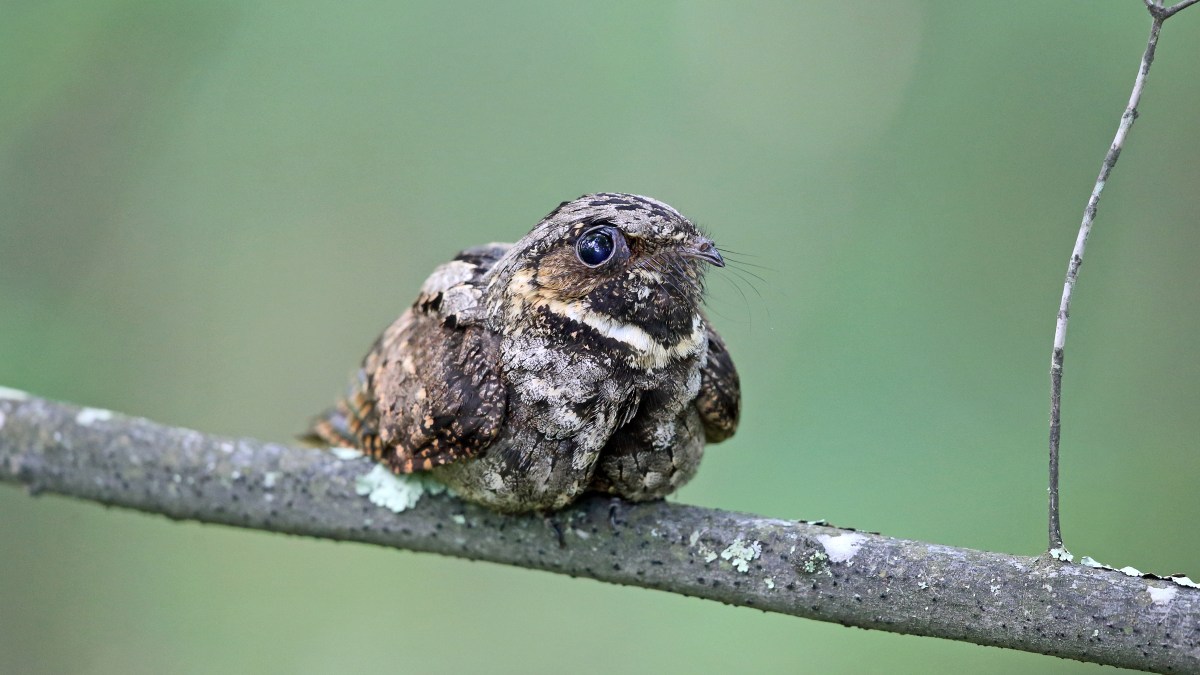
Birds are real. And everywhere. Three-quarters of the U.S.’s independent coffee shops display photographs of birds, usually cardinals or Black-capped Chickadees. Every epic film or television show eventually pans to ominous flocks of crows or ravens. (Fake facts, both.) If you go birding in the right cultural niches, you’ll also find Whip-poor-wills.
10. Zelda – Breath of the Wild (2017)
As a kid of the 80s and 90s, it warms my heart that the 2017 version of The Legend of Zelda, entitled Breath of the Wild, features the call of the Whip-poor-will. This isn’t a version of the call, but the call itself. And always from some hidden perch, out of view. Perfect.
9. The Barton Bedtime Stories – Whisk Whip-poor-will (1920s)

Before Disney and its interminable cast of animal characters came along, The Barton Bedtime Stories entertained children from Boston to Sacramento. A weekly story that ran in the nation’s newspapers, the Stories features a cast of real birds doing unreal things.
Whisk Whip-poor-will was among them. Apparently, there was a time when the Whip-poor-will was well enough known that a syndicated children’s story could prominently feature the species to dramatic effect.
The summer of 1921 was especially challenging for Whisk, who floated down a river, took a tumble with ducks, and had run-ins with toads and minks. I’m left wondering what might have been had Mickey Mouse, introduced later in the 1920s, had a Whip-poor-will for a companion.
In the late 1930s, a new children’s series by Thornton Burgess‘ similarly populated children’s imagination with birds, including Boomer the Nighthawk and Whip-poor-will.
8. Bert Goetz – The Whip-poor-will Swoop (1889)

A professional baseball player in the late-1800s, Bert Goetz is something of an enigma. An 1889 article in the Buffalo Morning Express lists his name as “Charles Goetz.” Modern sources list it as “George Burt Goetz.” His nickname was either “The Greencastle Giant” or “The Whip-poor-will Swoop.” The latter was also a name he gave for a “zig-zag” pitch he claimed to use to baffle batters.
This much is definitive, though. Goetz pitched in a single game, going 9 innings for the Baltimore Orioles in 1889. Goetz allowed 4 earned runs on 12 hits to the Louisville Colonels. He and the Whip-poor-will Swoop struck out two of the 39 batters he faced. Baltimore won in extra innings.
7. George Pope Morris – “The Whip-poor-will” (1838)

George Pope Morris‘ poem “The Whip-poor-will” transforms the bird into a specter who haunts the poem’s narrators with a question, “Why Whip Poor Will?” The poem is a bleak morality tale about the universality of sin and the absolute necessity of confession.
But use thee kindly--for my nerves,
Like thine, have penance done:
"Use every man as he deserves,
Who shall 'scape whipping?"--None!

Farewell, poor Will!--Not valueless
This lesson by thee given:
"Keep thine own counsel, and confess
Thyself alone to Heaven!"
Morris’ “The Whip-poor-will” was published widely in the Whip-poor-will’s nesting range. It appeared in newspapers across the northeast. It was also reprinted fairly extensively in collected volumes of American poetry, as well as in instructional books for schools. Perhaps a generation or more who encountered the bird would themselves be haunted by that question: Why whip poor will?
6. Boston Globe – Whippoorwill (1920s)
In the 1920s, a letter writer to the Boston Daily Globe‘s lifestyle section went by the penname Whippoorwill. Whippoorwill shared recipes (orange filling, molasses sauce, liver loaf). Writing from the mountains of New Hampshire, Whippoorwill also dispensed wisdom, including advice on curing kittens of constipation.
5. James Thurber – “The Whip-poor-will” (1941)
Kept awake by an excessively loud Whip-poor-will, Mr. Kinstrey, the protagonist of James Thursber’s 1941 story, “The Whip-poor-will” descends into madness, then violence. The madness takes the form of a repetitive chanting–“Sit-down-there, Sit-down-there” opens the story–meant to mimic the Whip-poor-will’s call. For me, it strikes just a bit too close to the stuttering states in which insomnia leaves some of us.
The violence takes the form of a murder-suicide. In this, Thurber’s story is meant to conjure superstitions that link Whip-poor-wills with death. But the story is less about the omens surrounding the bird and more about toxic white masculinity. As Kinstrey descends into madness, he belittles his wife Madge and his Black domestic workers. None accepts his complaints of sleeplessness to the chanting Whip-poor-will. The reader is left with the feeling that Kinstrey believes two things. The first is that all of them are too stupid to understand his plight. The second is that none deserves to doubt him.
So Kinstrey kills them all, and then he kills himself. This sets up a shaggy dog ending, involving a brief quip between the two officers investigating the killings.
Out in back, probably in the little strip of wood there, Lennon figured, a Whip-poor-will began to call. Lennon listened a minute. “You ever hear the old people say a Whip-poor-will singing near the house means death,” he asked.
Baird grunted and got in under the wheel. “Takes more than a Whip-poor-will to cause a mess like that.”
4. Magic The Gathering – “Whippoorwill” (1994)

I grew up MTG adjacent, with friends and family playing the card game. So this has a bit of a full circle feel to it. The game has a card featuring, of all birds, this bird.
Designed by Douglas Schuler, Magic the Gathering’s Whippoorwill card, from the 1994 “The Dark” set, features a lovely rendition of a Nightjar. The card evokes some of the superstitions and omens long associated with the Whip-poor-will as a collector of souls.
If the Whippoorwill remains silent, the soul has not reached its reward.
3. Edward Hopper – Cape Cod Evening (1939)

Edward Hopper’s most well-known painting has nothing to do with Nightjars and yet it’s named after one of them. “Nighthawks” features a crew of humans at a diner. There’s not a bird in sight.
Cape Cod Evening, on the other hand, manages to depict the essence of Whip-poor-wills: invisibility. According to the National Gallery of Art, the Whip-poor-will’s call is an “implied presence” in the work. This is especially so in Hopper’s depiction of the dog. Attentive not to the humans in the scene but to something beyond the frame, the dog’s “alert stance seems a portent of some
imminent danger; and the advancing darkness of evening imparts a melancholy
mood.” The Whip-poor-will, too, portends these.
According to the painter (and Hopper’s wife) Josephine Hopper, there’s no doubt about the Whip-poor-will: “The Whipporwill is there out of sight.” This may make Hopper the only artist to paint Nighthawks without painting Nighthawks and Whip-poor-wills without painting Whip-poor-wills.
2. H. P. Lovecraft – The Dunwich Horror (1929)

In The Dunwich Horror, H. P. Lovecraft invokes an old New England superstition about Whip-poor-wills: they collect departed souls. But Lovecraft’s birds are as twisted as this story. They gather in great numbers, calling incessantly around the deaths of the story’s characters, Old Whateley and his grandson Wilbur Whateley.
What are the Whateleys? Something unnatural. Likewise the Whip-poor-wills. They change their behavior, even migration, as human death approaches, to ensure they’re available to call maniacally and surely collect souls.
That Hallowe’en the hill noises sounded louder than ever, and fire burned on Sentinel Hill as usual; but people paid more attention to the rhythmical screaming of vast flocks of unnaturally belated whippoorwills which seemed to be assembled near the unlighted Whateley farmhouse. After midnight their shrill notes burst into a kind of pandaemoniac cachinnation which filled all the countryside, and not until dawn did they finally quiet down. Then they vanished, hurrying southward where they were fully a month overdue. What this meant, no one could quite be certain till later. None of the country folk seemed to have died—but poor Lavinia Whateley, the twisted albino, was never seen again.
1. The Smurfs – “The Last Whippoorwill” (1986)
The Smurf‘s 1986 episode “The Last Whippoorwill” features a bird that’s clearly a Whip-poor-will-Pigeon hybrid. This imagined species coos like a pigeon and nests in a tree in ways a Whip-poor-will won’t. And sure, the Smurf’s village appears to be in a feudal Europe where Whip-poor-wills weren’t. But the bird gives the famous three note call: “Whip-poor-will,” though without the accuracy of Zelda’s birds.
Despite its ornithological shortcomings, what makes this episode remarkable is its strong conservation message. Due to poaching and egg collection, Whip-poor-wills are nearly extinct. With the species gone, insects overrun Smurf village. (Whip-poor-wills are indeed insectivores.) After consulting with Mother Nature(!), the Smurfs go on a rescue mission to recover the last Whip-poor-will egg and restore ecological balance. Along the way, they teach an unscrupulous human boy a lesson in the compassionate treatment of non-human species.
Featured image by flickr user Tom Murray. Taken on July 3, 2017 Dunstable, Ma. Some rights reserved.
Leave a Reply