
Don’t try this at home: on October 28, 1855, Henry David Thoreau snatched an Eastern Screech-Owl right out of a tree. He brought the little bird home with him and kept it in a bird cage overnight.
Here’s Henry’s account of his night spent with a Screech-Owl (Megascops asio). It opens with him in his canoe, before veering through his rather unusual–and today, most definitely illegal–encounter with the owl.
Thoreau and an Eastern Screech-Owl
Oct. 28, 1855
As I paddle under the Hemlock bank this cloudy afternoon, about 3 o’clock, I see a screech owl sitting on the edge of a hollow hemlock stump about three feet high, at the base of a large hemlock. It sits with its head drawn in, eying me, with its eyes partly open, about twenty feet off. When it hears me move, it turns its head toward me, perhaps one eye only open, with its great glaring golden iris.

You see two whitish triangular lines above the eyes meeting at the bill, with a sharp reddish-brown triangle between and a narrow curved line of black under each eye. At this distance and in this light, you see only a black spot where the eye is, and the question is whether the eyes are open or not. It sits on the lee side of the tree this raw and windy day. You would say that this was a bird without a neck. Its short bill, which rests upon its breast, scarcely projects at all, but in a state of rest the whole upper part of the bird from the wings is rounded off smoothly, excepting the horns, which stand up conspicuously or are slanted back.
After watching it ten minutes from the boat, I landed two rods above, and, stealing quietly up behind the hemlock, though from the windward, I looked carefully around it, and, to my surprise, saw the owl still sitting there. So I sprang round quickly, with my arm outstretched, and caught it in my hand. It was so surprised that it offered no resistance at first, only glared at me in mute astonishment with eyes as big as saucers.

But ere long it began to snap its bill, making quite a noise, and, as I rolled it up in my handkerchief and put it in my pocket, it bit my finger slightly. I soon took it out of my pocket and, tying the handkerchief, left it on the bottom of the boat. So I carried it home and made a small cage in which to keep it, for a night. When I took it up, it clung so tightly to my hand as to sink its claws into my fingers and bring blood .
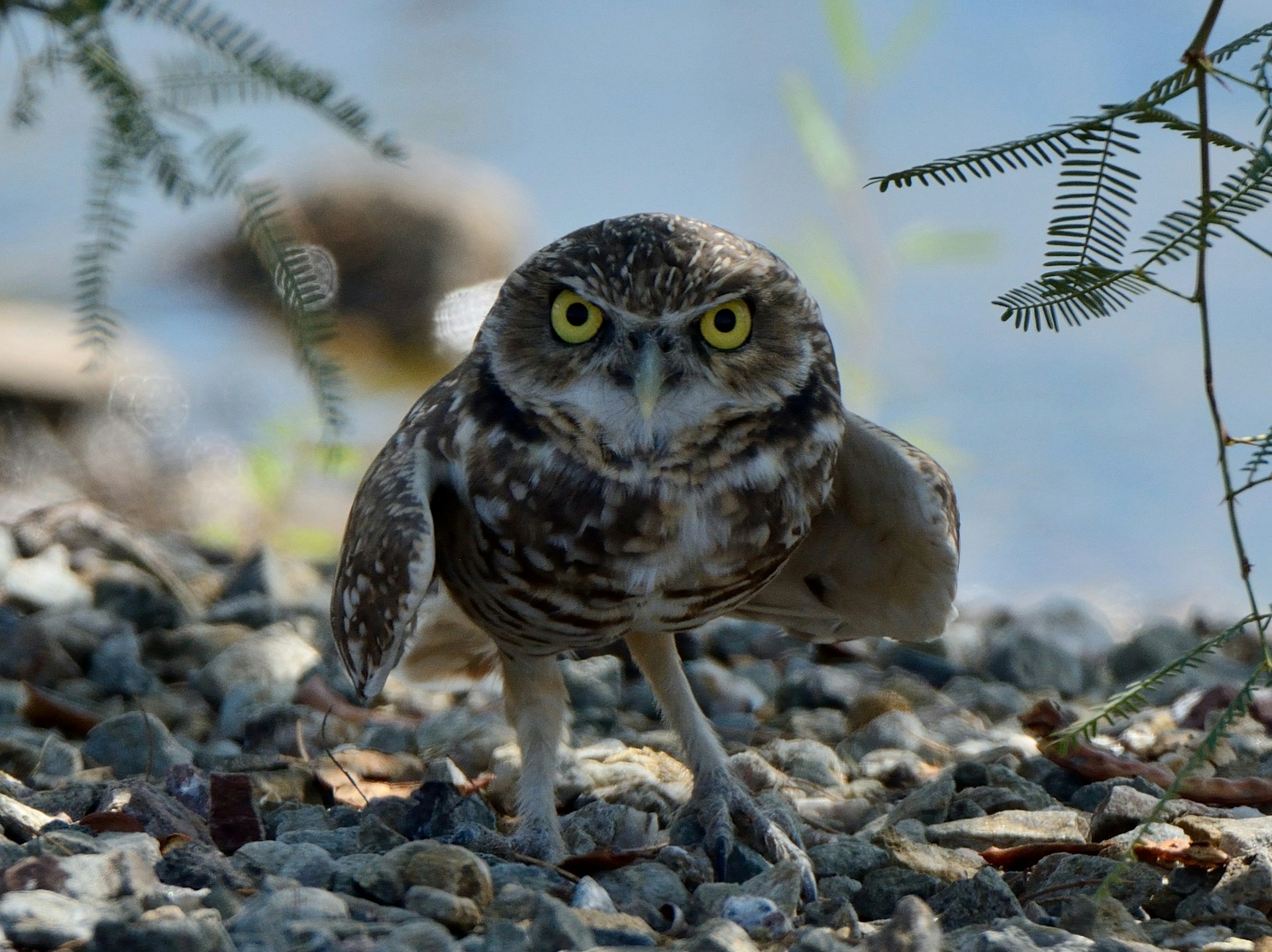
When alarmed or provoked most, it snaps its bill and hisses . It puffs up its feathers to nearly twice its usual size, stretches out its neck, and, with wide-open eyes, stares this way and that, moving its head slowly and undulatingly from side to side with a curious motion.
While I write this evening, I see that there is ground for much superstition in it. It looks out on me from a dusky corner of its box with its great solemn eyes, so perfectly still itself. I was surprised to find that I could imitate its note as I remember it, by a guttural whinnering.
A remarkably squat figure, being very broad in proportion to its length, with a short tail, and very cat-like in the face with its horns and great eyes. Remarkably large feet and talons, legs thickly clothed with whitish down, down to the talons. It brought blood from my fingers by clinging to them.
It would lower its head, stretch out its neck, and, bending it from side to side, peer at you with laughable circumspection; from side to side, as if to catch or absorb into its eyes every ray of light, strain at you with complacent yet earnest scrutiny. Raising and lowering its head and moving it from side to side in a slow and regular manner, at the same time snapping its bill smartly perhaps, and faintly hissing, and puffing itself up more and more, — cat- like, turtle-like, both in hissing and swelling. The slowness and gravity, not to say solemnity, of this motion are striking. There plainly is no jesting in this case.
General color of the owl a rather pale and perhaps slightly reddish brown, the feathers centred with black. Perches with two claws above and two below the perch . It is a slight body, covered with a mass of soft and light- lying feathers. Its head muffled in a great hood . It must be quite comfortable in winter. Dropped a pellet of fur and bones (? ) in his cage. He sat, not really moping but trying to sleep, in a corner of his box all day, yet with one or both eyes slightly open all the while. I never once caught him with his eyes shut. Ordinarily stood rather than sat on his perch.
Credits
All photos by Joshua J. Cotten on Unsplash
Excerpt from Thoreau’s journal from Thoreau’s Bird-lore, edited by Francis H. Allen (1910).
Leave a Reply