
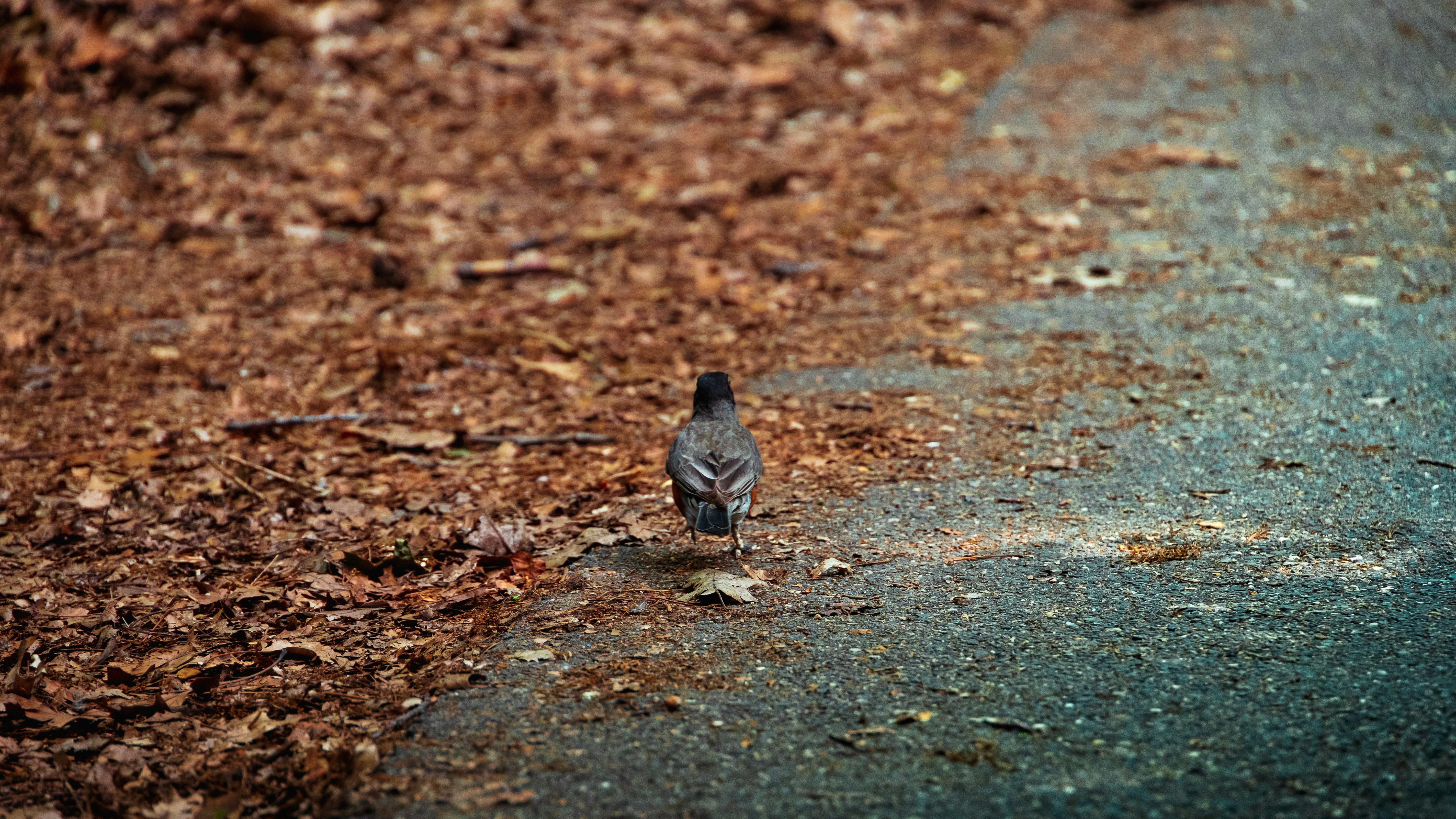
A story from a decade ago. February 9, 2014, woke Denver’s birds with cold: twenty or so Fahrenheit degrees. But with the sun, the cold gave way to a warmth that forecast spring. And so it came as no surprise to find a dozen and half or so American Robins busily feeding at the southeast corner of Cheesman Park.

Ordinarily, I pay no attention to robins. They are as common as crows and chickadees, but they seem to me to lack those two species’ personalities. Crows and chickadee interact with us. Even those who keep a distance seem to investigate us first, before moving on.
Robins, though, do what most songbirds do: just fly away. Or else, in their cartoonish sort of way, they run away, twiggy legs flicking back and forth.
Not even the iconic status of robins in U.S. culture saves them; to encounter any one member of the species is to encounter any. Everything they do seems stereotypic — from that run to pulling earthworms from the ground.
The image of a robin pulling an elastic worm from the ground is familiar enough that, I suspect, most of us probably imagine that all birds do this.
The early bird gets the worm, after all.
Heeding the Common Birds
At least that is how robins seems to me, but, then again, I’ve hardly heeded them. That day, ten years ago in Dencever, I did.
I decided to try photographing them closely, watching them as they foraged and moved back and forth between the two thawed sections of grass on either side of 8th Avenue, which borders Cheesman Park.
I knelt, took a few photos, then laid down on the thawing ground to try to get a photo of the bird from its own birds-eye view of the world. The soil was damp and cold, and it didn’t seem as if the posing bird in front of me wanted to do much but watch me back. So I gave up quickly. And it was apparent that I’d only catch them in flight if I approached too closely, something that I wasn’t so interested in doing.
So I took off toward my car. As I did, I noticed one robin in a small, leafless tree. It held steady though I stood a foot, not more, from it. I photographed it, snapping about a dozen photos.

Those dozen photos span 16 seconds; the series of photographs that I took started at 11:33 AM (and 34 seconds) and ended at 11:33 and 50 seconds.
Four Seconds in the Life of a Robin
Then, everything changed. The robins went skyward at once. I saw very little. I don’t think the birds moved as one, like some flocking birds would. I believe they went every which way — seeking the nearest covered branch. The bird near me, perched still, defecated, the first sign of the flight instinct kicking in.
When I first started birding in April 2012, I did not know how to interpret this sort of behavior. I watched it twice, songbirds scattering, a bright male cardinal shooting by, pursued by a hawk.
Only later was I able to piece this accidental evidence together with the advice given by field guides and more experienced birders about how birds respond in the presence of a predator.
I once watched, an entire river empty of ducks and geese, a bit baffled until a juvenile bald eagle flew in after them and explained the whole thing.
I’m learning, though. When a thousand or more starling, seagulls, and crows hit the air at once at Rocky Mountain Arsenal National Wildlife Refuge last autumn, I knew enough to stop in my tracks and walk back toward the explosion. On the other end of it was a single Great Horned Owl, who had caused the whole mess.
Four seconds after I took my final photograph of the perched robin, a hawk stood on the sidewalk, 8-10 feet from me, a robin pinned under its talons.
Four seconds it took for the bird to explode from its hidden roost, snatch one robin, land, and begin the act of killing. My guess is that the hawk is a juvenile Sharp-shinned Hawk. Her heavily mark chest, relatively small head, and the faint white eyebrow seem consistent with that identification.
Hawks, Robins, and the Necessity of Tragedy
There are two things that I should say about this act. Three, actually. The first is that I photographed it. One appears below. It strike me as a sad photo, so just some forewarning. The second is that the Cooper’s and Sharp-shinned Hawks kills by constriction, which means that they suffocate their prey by crushing their preys’ throats with their talons.
The third is that I have seen raptors with prey before. I came upon an American Kestrel with a sizable mammal, out in Thornton, Colorado last winter. About the same time, I came upon a Red-tailed Hawk pouncing on a dead squirrel; it is not clear to me if the hawk actually killed the squirrel or happened to come upon it, since I watched the hawk leave a tree then stroll over to the already dead squirrel. And I’ve seen a bald eagle pull a fish out of the St. Louis River in Cloquet, Minnesota.
But until this encounter, I had 1. Never seen a hawk actually catch another bird, though I’ve seen them try and 2. Never seen any of those birds kill their living prey. So I was unprepared for what happened next.
The hawk, having landed on the robin, seemed to stand on it. The robin let out a cry. It was a terrible scene. The poor robin’s beak was agape, a fact captured in the photographs.

I considered doing the human thing and clumsily intervening, throwing my hands up, shouting, rushing the hawk. But I fought that urge, for I thought it would have left one hungry hawk and one wounded robin. (Having learned that Sharp-shins and Coopers kill by constriction, I’m not so sure that the robin would have, in fact, been injured had I stopped its killing.)
I also deemed it inappropriate. Birds do not abide the same moral imperatives as humans; this sort of killing is not murder, not criminal. I’m not even sure it is grieved by the other robins.
So I stood, watching and photographing, for the twenty-eight seconds or so it took the hawk to kill the robin. It then flew off with its kill, leaving me jarred, I’ll admit it.
Had I stumbled upon the scene, turning a corner to a hawk with a single, dead robin, I don’t think that I would have felt this way. Instead, I had spent a time — a brief time, yes, but time — with these robins and felt, in some small way, briefly involved in their little lives and activity. I felt attached, weakly but attached nonetheless, to these little, nondescript, common birds. And here had been one, taken by surprise as I had been by the hawk’s attack and killed.
At the time, robin’s final gasping call signaled to me the bird’s awareness of and struggle against what was happening. I’m now not as sure; the call may have been mechanical, the air forced out of the robin’s lungs by the hawk. But that call…well, to me, a dumb birder, a dumber human…sounded like a calling out, a beg for help from the crowd of robins and human or else from something even more impossible: mercy from a hawk.
I left the corner of Cheesman, looking at the photos as I made my way home. I wondered if I should have scared off the hawk, postponing its violence until I wasn’t around to see and superficially mourn its victim. Then I recalled, as a boy, a dying robin I kept in a shoebox, foolishly surrounded by grass and earthworms. I don’t know who in my family found it, but I suspect it was my father. I certainly don’t know who thought it was a good idea for me to try to nurse it back to health. Its breathing slowed over time. How long? I don’t remember, but I think it remained alive but dying for a day or two. I recall burying that box with the dead robin in it on Memorial Day, which seemed to me, as a child, an especially appropriate thing to do. This is now only the dimmest of memories, the sort of which may or may not be true after all.
So much for not having heeded the lives of this little, backyard bird.
Leave a Reply