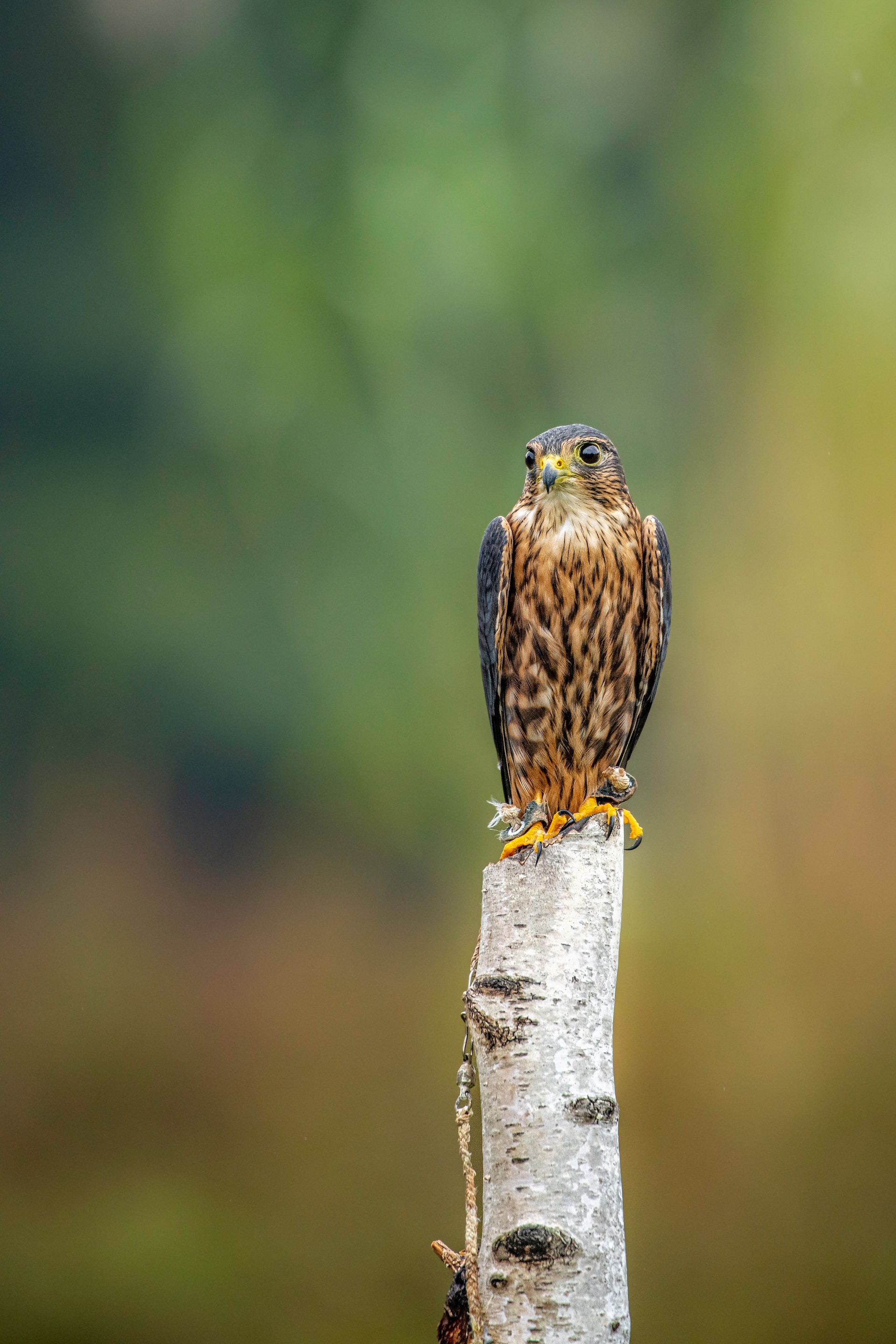
This is the first installment of Final Friday Folklore, a monthly theme I’m starting in 2024. This month features Merlins (Falco columbarius or Pigeon Falcon). They are wicked falcons indeed, at least from the perspective of the songbirds they hunt without mercy.
“Small, fierce” falcons is how the Cornell Lab of Ornithology describes them. And I can attest. I have stood beneath Merlins as they’ve transformed sparrows and thrushes into snowfalls of feathers.
Here’s one, who Denver birder Joe Roller and I watched with a junco, back on New Year’s Day 2020.

Merlins are widespread, spanning nearly the entire Northern Hemisphere. Today’s folklore comes from England, where the species is especially significant.
After all, the species shares its name with one of the country’s most famous wizards, though who came first — Merlin the bird or Merlin the Wizard — appears open for debate.
Merlins and Robin Redbreast
But this month’s folklore has nothing to do with wizardry. Rather, it’s one that links Merlins with another bird rich in meaning, the European Robin. Robins, which have no real relation to American Robins, are also known as Robin Redbreast. And it’s that fiery chest that earns the species their place in this lore.

A 1576 poem by the poet George Gascoigne is the source of a legend linking the Robin and Merlin.1
Real life Bushtits huddle together to survive cold nights. Gascoigne’s Merlins collect Robins, imprisoning them for the heat their fiery chests provide.
Or as the red breast byrds,
The Complaint of Philomene by George Gascoigne
Whome prettie merlynes hold,
Ful fast in foote,
by winter’s night
To fende themselves from colde.
Robins and the Fires of Hell
Merlins can be excused for believing that Robins carry fires in their chest. After all, the English believed the Robin’s’ red chest was equal parts sacred and profane. One set of legends held that Robins got their redbreasts from sharing in Christ’s suffering on the Cross. In on story, the birds actually carried a drop of God’s blood in their vein.
Another legend offered a rather different origin story: the fire of the Robin’s breast “emanated from Hell,” as the writer Peter Tate puts it in his book Flights of Fancy. But Robins were on the side of humans even in this story. Their trips to Hell were only to bring water to the condemned.2
The generosity of Robins did not go unnoticed. In many legends, including some involving Thor, Merlins were protected species. Harming them or their nests meant trouble: a lightning strike here, a lost limb there (for the cat who would molest a Robin)
No word on what happens to the Merlin who collects the birds for their fires. But we might assume that the great little falcon went unpunished. After all, Gascoigne has the falcons release the Robins out of “pitie” for the tinier birds.
Notes
- Gascoigne’s lines about Merlins and Robins can be found in the “Myths of the Robin Redbreast in Early English Poetry,” an article that appears in an 1889 issue of The American Anthropologist. The article was written by Dr. Robert M. Fletcher, an amateur folklorist and Union doctor during the Civil War. My former colleague A.S. shared this article with me a few years ago.
- Peter Tate documents this in Flights of Fancy, pages 118-124.
Featured Photo by Jeremy Hynes on Unsplash
Leave a Reply