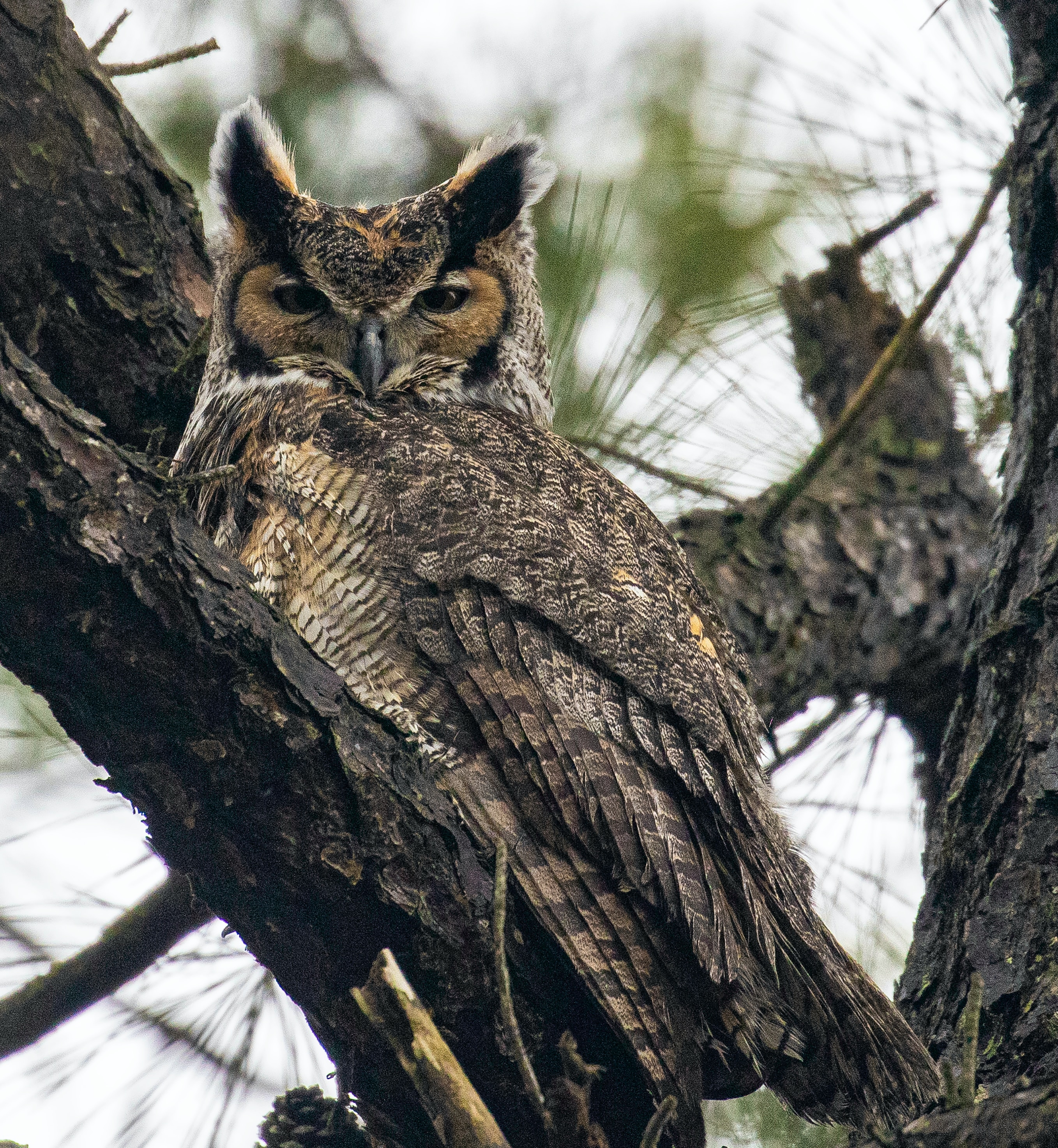
As any birder knows, owling is possibility, not promise. We go out into the dark evening, often in winter, carrying hope and little else. Will we hear an owl? Will we see one?
One hundred and seventy years ago, before owling was actually a thing, Thoreau went a-owling. His journal entry for January 7, 1854, well describes the challenges and contradictions of owling and birding more generally.
When we most try to see or hear a bird, we’re often less likely than when we give up on the effort.
Jan. 7, 1854. I went to these woods partly to hear an owl, but did not; but, now that I have left them nearly a mile behind, I hear one distinctly, hoorer hoo. Strange that we should hear this sound so often, loud and far, a voice which we call the owl, — and yet so rarely see the bird. Oftenest at twilight. It has a singular prominence as a sound ; is louder than the voice of a dear friend. Yet we see the friend perhaps daily and the owl but few times in our lives. It is a sound which the wood or the horizon makes.
From Thoreau’s Bird-Lore, edited by Francis H. Allen (1925)
It is a lovely way of putting it: “A voice which we call the owl.” The bird heard, but unseen is always that — a voice that refers to the feathered one who makes it.
Nocturnal birds are especially like this, cloaked by dark and their own invisibility. Like the Whip-poor-will, who is only his song. Like the “hoorer hoo,” the owl who Thoreau does not name.
Credits
Header Photo by Liz Guertin on Unsplash
Leave a Reply