On Saturday, I took a walk at a local open space. I only brought my camera, because all I hoped to do is photograph the Northern Shrike visiting the marsh at the open space. I quite like shrikes, though no one would describe them as rare birds. But they break up the monotony that I perceive in winter — the flocks of juncos I could work harder at id’ing at the subspecies level, the dormant plant after dormant plant.
And I did photograph the shrike. But he or she remained far too high for a decent look. Then, they disappeared into the marsh.

I expected the rest of the walk to be unremarkable. I photographed dry seed heads with snow on them and tried to transform every Song Sparrow (many) into a Swamp Sparrow (none).

But then, in a tangled willow thicket at the edge of the marsh: a wren.
“It’s the Hope That Kills You” – Rare Birds @ Me.
Without binoculars, I watched the wren-sized bird do wren-like things. Hop around branches. Skulk a bit.
It didn’t do one wren-like thing, though: vocalize.
So without a good look, my hope ran wild. I knew I encountered a state bird for me, the appropriately seasonal Winter Wren.
That’s the wren we see around Denver in December, right?
Right?

No.
A few bad photos, then a few decent ones.
The bird was rarer yet, at least for December: a House Wren. In other words, a perfectly common (spring – autumn) species of wren, but one who is usually not around in December.

Perfectly lovely and seemingly content despite the cold — and yet, from my perspective, the wrong bird.

More. Dumb. Hope.
The rest of the walk was House Finches, Magpies, and, near it’s conclusion, a hovering Kestrel who I failed to photograph. I left the open space, got some espresso, then went home.
Pulling into my driveway, I spied an accipiter in a neighbor’s tree.
Badly lit and from a few houses away, my heart told me that this was the bird formerly known as Northern Goshawk. My breath caught in anticipation. But I couldn’t make out field marks from a house or two away.
I snapped some photos.
I reviewed the photos.
Nope.
Just your run-of-the-mill backyard accipiter, common enough that I haven’t yet scrutinized my photos to get an id.

Nothing about the bird actually conveys Goshawk. So what was it that I saw in the silhouette?
More. Dumb. Hope.
“I Believe in Hope” – Ted Lasso
Once home, I put my disappointment and my camera away. I leashed my dogs. We walked around the block, them doing their slow doggy thing.
I figured we’d go one way. They decided on the other.
Good thing, too.
Around the block — magpies, first one, then a half dozen.
Among them a rather white-gray, buteo-sized raptor.
Goshawk?
Wait.
Really?
Or. More. Dumb. Hope?
The dogs, oblivious to my renewed hope, kept sniffing around.
We got closer. Without optics, I strained to make out field marks. But even without binoculars, I could tell that the hawk lacked the Red-tail’s belly band. It also appeared to have the white eyebrow of an adult American Goshawk.
My smartphone, zoomed in as far as possible, confirmed?

The Rare Birds Formerly Known as the Northern Goshawks
I saw my first Goshawk in 2016, when they were still called Northern Goshawks. Then, too, I was walking my dog, but I only had one at the time, Iggy. (Which reminds me: Happy Adoption Day, Andre!)
Then, Iggy and I raced home so I could view my crummy photos of a briefly seen bird.

Goshawks aren’t exactly rare in Colorado. They nest in the mountains, at higher elevations than Denver and its southern suburbs. But they’re by no means common or predictable. They come down — perhaps from our mountains or perhaps from the northern states? — to the Front Range in relatively small numbers in winter, particularly after snows. (I call this “Goshawk Weather”: a sunny day after a snowy cold one, as it’s particularly good for going out with binoculars, a camera, and hope for this bird.)
Down here, eBird flags them as rare birds. And I only usually see one or two of them in a winter. And I don’t see them every winter — in fact, the last time I saw one was 2019.
So every encounter is remarkable. And unexpected — even if I hadn’t previously primed myself to see a Goshawk by mistaking a much smaller accipiter for one.
This time, I raced home with my dogs to settle them back in with a plate of food. I grabbed my binoculars and headed back out.
Happily for me, the hawk was still there. So I was able to get some solid looks and photos.


I’m writing a book about Whip-poor-wills in American culture. Sign-up for my newsletter to receive seasonal updates about it, beginning in 2024!
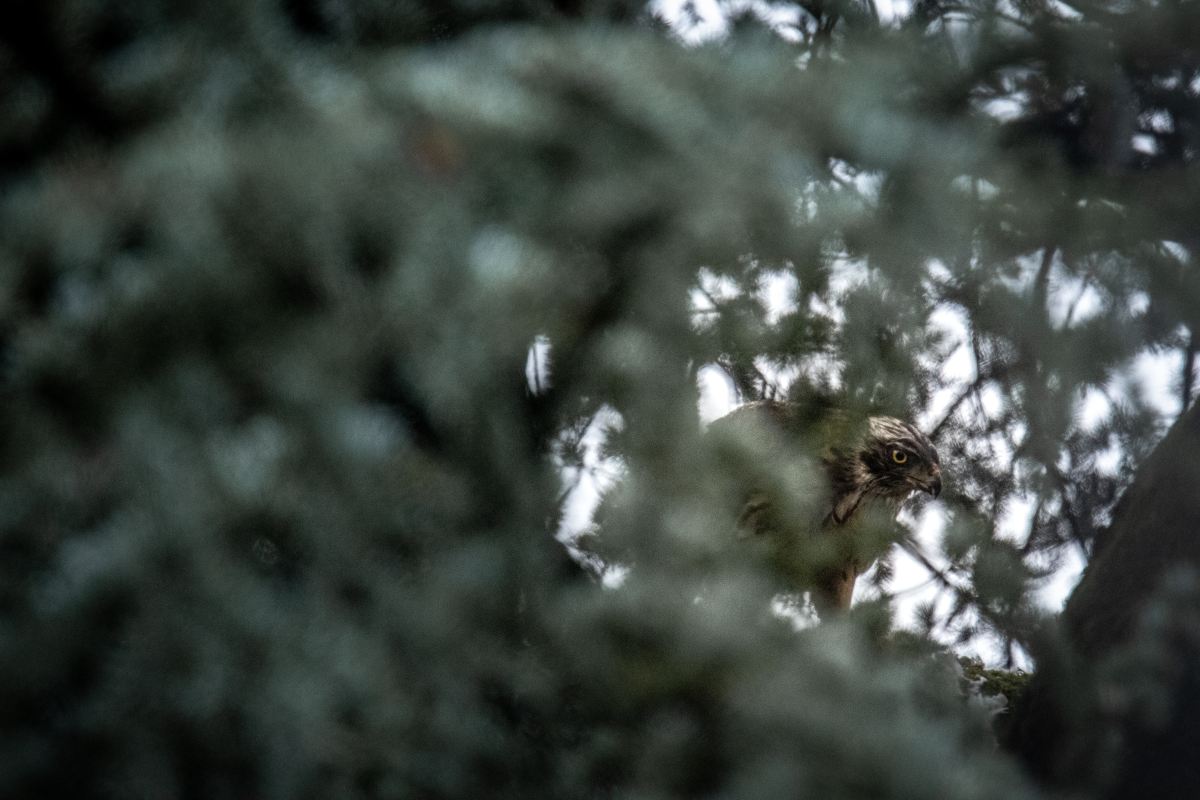
Header Photo of the Now Eurasian Goshawk by Julien DI MAJO on Unsplash

Leave a Reply