
Here’s one thing that every birder knows about nightjars (Family Caprimulgidae, “the Goatsuckers”): You’re more likely to hear them than see them.
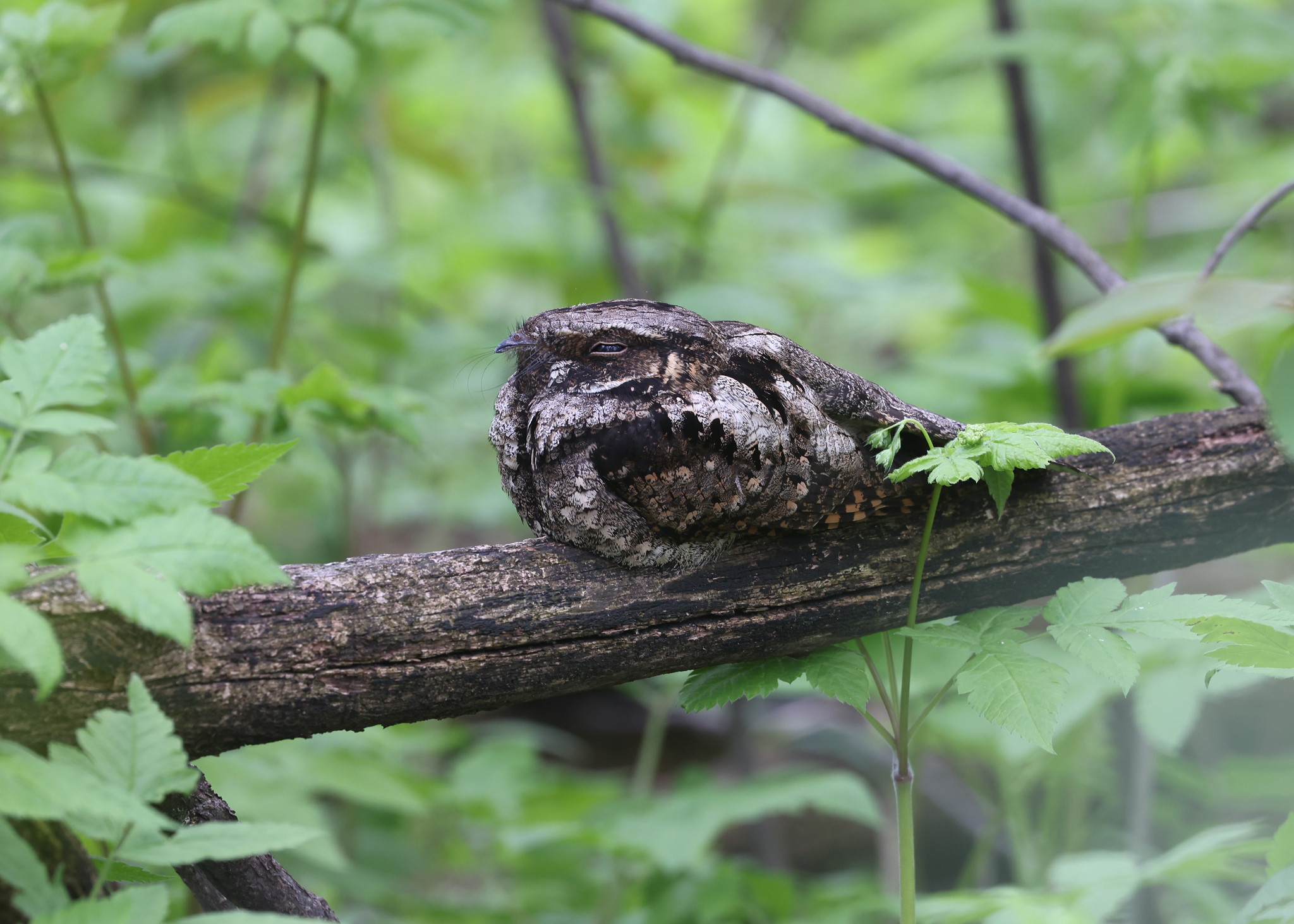
They are, after all, “secretive” birds. During the day, nightjars — our Colorado locals are Common Poorwill and Common Nighthawk — are usually inactive and hidden, concealing themselves on forest floors, tree branches, or rocky ground. With feathering that resembles pebbles, lichens, or rotting wood, nightjars match their nesting habitats just so. They may seem uncommon or rare, but they are found everywhere except Antarctica and a few island groups.
Not only have these wide-mouthed twilight fliers perfected camouflage, they have also refined its use. A 2017 study found that three kinds of nightjars — Mozambique, Pennant-winged, and Fiery-necked — better matched the backgrounds they chose for roosting than any others. Whether all nightjars do this blending in is unclear. But photos of many nightjars show how well they disappear into their background.
In this regard, the photo here of two Freckled Nightjars (Caprimulgus tristigma) in Uganda is especially compelling. The one in front virtually vanishes into its rocky habitat. The white “flakes” of lichen or light-colored stone match perfectly the lightly speckled feathering of this bird.

Invisible by day, nightjars remain difficult to encounter at night. Some including Common Poorwill are most active at the end of dusk. Light is low, trails are closed, and our human imaginations — still just a little afraid of the dark and who or what lurks within it — can get the best of us.
Besides being secretive, shy and reclusive, Nightjars are also more scarce than they used to be. Across most of the US and Canada, breeding populations of nighthawks, Whip-poor-wills, and Chuck-will’s-widows have tanked precipitously — more than 50%. Although Colorado isn’t exempt from this trend, we seem to be losing poorwills and nighthawks at a slower rate. Between Colorado Breeding Bird Atlases I and II, observations of breeding Common Nighthawks declined by about 20%. Total Common Poorwill observations declined by about 10%.
All told, nightjars are difficult to find, nearly impossible to spot, and challenging just to add to our yearly bird lists. Often it takes a special trip to niche nightjar habitat to encounter a poorwill or nighthawk.
But there’s another secret these birds keep from us: They’re not nearly as reclusive as we think. When cold spring rains compel migrating birds to spend a night in backyards, alleys and streets around Denver and its suburbs, think of it as “poorwill weather.” Amid or immediately after a cold, mid-to-late-May rain, go looking for poorwills — in mulch piles between trees, in rocky gardens, anywhere on the ground and seemingly out of the way where they can blend in.
This year, Denver had days of poorwill weather in late May, including a torrential rain on May 25 that brought a poorwill into my Centennial yard. I’d have missed him had I not stepped into the kitchen to make lunch just as he swooped low through the yard, within view. His white-tipped tail and warm browns were visible in flight, but once the bird entered the complex coverage of trees and shrubs at the edge of my yard and the neighbor’s, he disappeared.

If nightjar weather is typical, where the birds land is not. Migrating poorwills even show up in downtown Denver. When I shared my report of that backyard bird to the CoBirds list-serv, DFO’s own Mike Fernandez replied that he’d recently encountered one downtown during a “Lights Out Denver” bird window-strike survey. The poorwill in his photo was alive and fine, looking at ease on a patch of sidewalk. Somehow its feathering matched a low rock wall in the background.
During these on-the-ground stopovers, Common Poorwills generally tolerate passersby, though they’ll likely flush if approached directly. But a steady, passing stream of oblivious people is nothing to a poorwill. Particularly on cold mornings, poorwills may remain hunkered down indefinitely. This allows anyone with a camera, birder or not, to snap clear and close-up photos of them in surprising locations. I’ve seen pictures of Common Poorwills on Facebook, Nextdoor and iNaturalist, roosting on cars, sidewalks, and the edges of garden boxes and patios.
Common Nighthawks are a bit different. Because of their high, crepuscular flights (in evening and morning twilight) over open spaces, water, and cities, people see them more often than Common Poorwills, whose behaviors are less conspicuous. Still, it can be as hard to notice or spot a roosting nighthawk as it is a poorwill. Nighthawks sometimes rest on fence posts and branches, particularly on the Plains east of Denver. But like poorwills, nighthawks can easily blend into their surrounding habitat. Good luck spotting one perched high in a tree canopy after leaf-out! And ground-roosting nighthawks can disappear into sand and stone just as easily as a poorwill can.
Though they can be difficult to find, that doesn’t mean nighthawks avoid living among us. As late spring turns to summer, Common Nighthawks begin nesting, sometimes on flat, gravel-covered roofs in cities (a behavior first documented in 1869). Biologists speculate that nighthawk populations may have increased as humans used gravel to cover more roofs. Unfortunately for Common Nighthawks, gravel has fallen out of fashion as a roofing material in American cities. That change in our built environment may be a factor in the species’ decline.
Common Nighthawks aren’t the only such roof-nesters. In Taiwan, the Savanna Nightjar began nesting on urban roofs about two decades ago. But its nighttime vocalizations are so loud and intrusive — Birds of the World describes it as “a loud, raspy note cheek! or tschreep! repeated for long periods” — that they keep some people up too late and roust others from sleep way too early. Perhaps to forestall extreme measures to control or remove the birds, conservationists in Taiwan preach peaceful coexistence. They ask that people use their rooftops regularly to hang laundry or conduct other activities to dissuade nightjars from nesting there. Agricultural and science authorities even collaborated on posters to promote this strategy.
People in the eastern US can relate. Whip-poor-wills there are notoriously vociferous. Their scientific name says so: Antrostomus vociferous, Latin for “clamorous cavern-mouth.” Although Henry David Thoreau wished in his own journal that everyone could sleep “where you may hear the whip-poor-will in your dreams,” not everyone shared his enthusiasm. More than a century ago, the species was so common that sleepless nights were ensured around homes in the East. A 1907 article in the Washington Times even told of a man so annoyed by a Whip-poor-will that he shot at it three times and missed. In a final indignity, the bird landed on his gun barrel and sang.
I can’t confirm if that story is real or apocryphal, but Whip-poor-will as nuisance had enough cultural currency to inspire the writer James Thurber’s dark, Hitchcockian 1941 short story, “The Whip-poor-will.” Thurber’s sleepless human protagonist is driven murderously mad by days of unending Whip-poor-will song.
As Whip-poor-will populations have declined, the species keeps fewer people awake. But wherever the birds endure, so too does their song. Despite closed windows, I’ve heard an especially vocal one continue his song well past midnight under a May full moon. And I still hear from people back East who are kept awake by Whip-poor-wills.
Whether nighthawk, poorwill or Whip-poor-will, nightjars will never be as familiar as our common backyard birds. We’ll never witness their familial dramas the way we do those of robins, chickadees, and magpies.
But we shouldn’t mistake our inability to spot them regularly for a species quirk. Who among us doesn’t sometimes wish to be like a nightjar, spending spring and summer afternoons hidden away in difficult-to-reach places, keeping company with songbirds, oaks, and the quiet of rocks? Nightjars are neither recluses nor curmudgeons . . . or, at least, no more so than many of us birders, myself included.
_________________________________
This blog post originally appeared as an essay in the Summer 2025 issue of Denver Field Ornithologist’s quarterly, The Lark Bunting. Thanks to Pat O’Driscoll for the sharp editing.


Leave a Reply