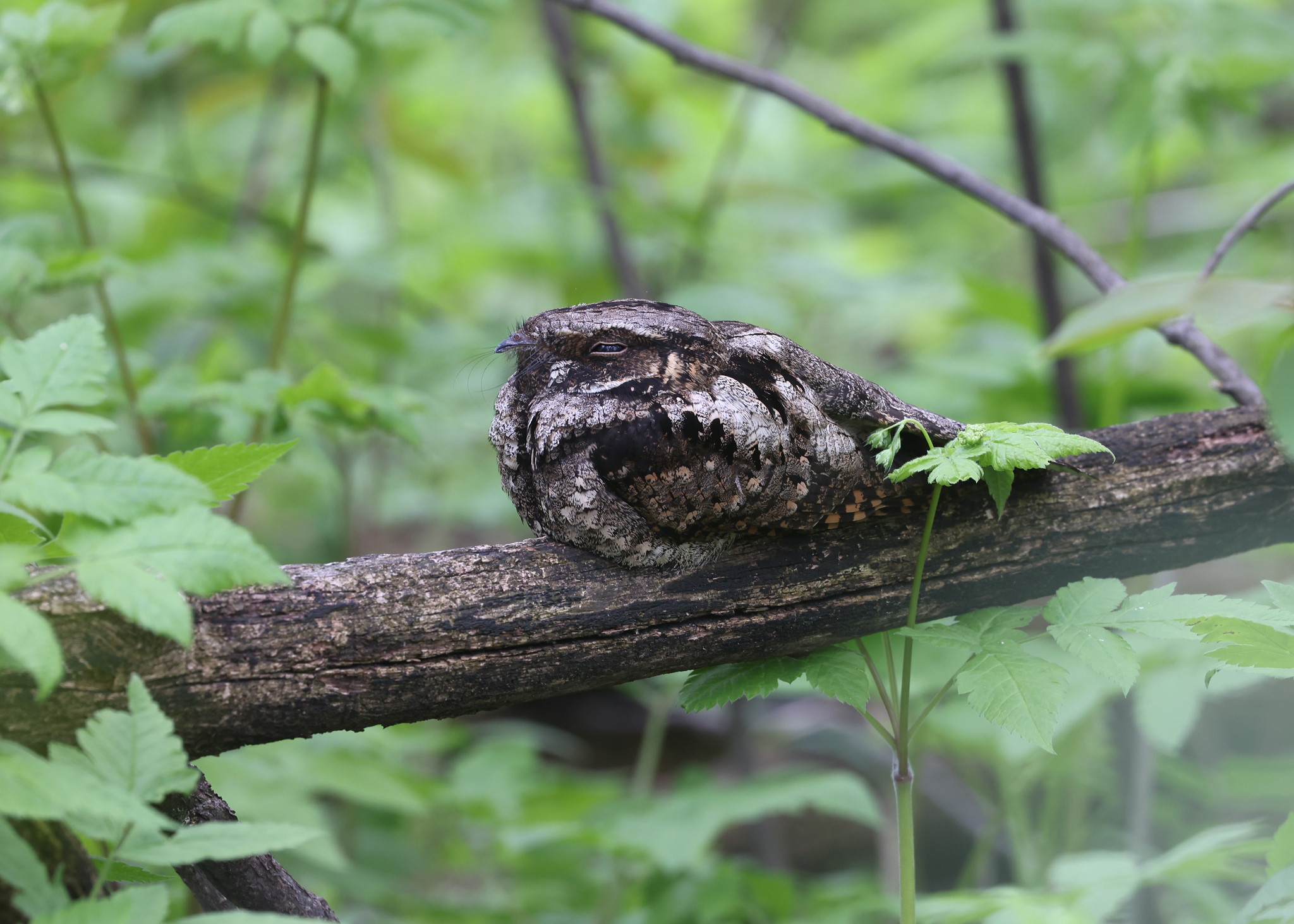
Eastern Whip-poor-wills are iconic birds of the eastern U.S. Their song once defined the seasons, inspired our poets, and consoled the lonely. But over the past half-century, Whip-poor-wills have disappeared from the American landscape.
According to the bird conservation organization Partners in Flight, Whip-poor-will populations have declined by an estimated 69% since the 1970s. These declines are happening across most of their breeding range.

Though Whip-poor-wills are not considered an endangered species, they’re considered “Near Threatened.” And through much of their breeding range, they’ve been identified as species of “Special Concern” or “Conservation Need.”
Locally, Whip-poor-will populations began disappearing even before the 1970s. In 1925, the naturalist E.D. Nauman wrote about the decline of Whip-poor-wills in southern Iowa. Nauman thought the disappearance of Whip-poor-wills had to do with agricultural development. In the mid-1950s, the journalist Lucy Templeton documented their decline in central Tennessee. Templeton, too, blamed habitat loss – in this case, for suburban development.
Habitat loss may not be the only driving force. Changing agricultural practices, the decline of large beetles and moths, predation, car strikes, and light pollution may all be contributing factors. Amid all of this, life can get difficult for Whip-poor-wills. And it can be hard to know how to help such a mysterious, rarely seen bird.
Fortunately, there are things we can do. Here are four steps to take to support Whip-poor-wills.
1. Whip-poor-wills need young forests. Support science-based forest management. 🌳
Habitat loss threatens Whip-poor-will populations. This is true in places where residential, commercial, and agricultural development have swallowed forests whole.
Counterintuitively, it’s also true in places where extensive forests dominate the landscape.
Eastern Whip-poor-will populations tend to be highest in diverse forests of young and mature trees. These are forests with a “mosaic of diverse structural and forest age class conditions,” according to one recent large-scale study of the species.
Picture a healthy forest. If you’re like me, you likely picture an undisturbed stand of middle-aged trees. After all, this is how the landscape now looks throughout much of the eastern US.

Unfortunately, these forests don’t provide the hunting and nesting habitat that Whip-poor-wills need. While Whip-poor-wills like extensive forests, they also need access to open, early successional forests.
Biologists find that Whip-poor-wills are most numerous in forests with open canopies. They think it’s because the birds tend to hunt from low perches, flying upwards in their pursuit for flying insects. An open canopy allows moonlight to break through. This backlights insects and makes hunting a little bit easier for Whip-poor-wills.
Once, fires, beavers, even mastadons(!) would maintain open canopies in otherwise extensive forests. Now, humans have to. Using science-based forest management strategies, we can create the habitat that Whip-poor-wills and other young forests specialists need.
Forest management is not exactly the most popular practice with the public. Many of us don’t understand its use. And we mistake the open forest it leaves in its wake for an unsightly scar. Because of this, forest management needs support among birders, landowners, and conservationists.
What you can do
✅ Visit youngforests.org to learn more about early successional habitat. And check out their guides “How to create young forest” and “Why young forest?“
2. Plant native oaks 🌱
Across much of the U.S., oaks are the engine of biodiversity. This is because the larvae of many insects, especially moths, have evolved to feed on oaks.
What does this have to do with birds? Most birds in the U.S. feed soft insects and spiders to their young. Oaks are buffets to parent birds.
As insectivores, Whip-poor-wills depend on oaks for food. And they also seem to prefer nesting near oaks, perhaps because their and their young have feathering that matches the coloring of old oak leaves. As one 20th century observer described them, young Whip-poor-wills are “thickly clothed with extremely soft, fluffy down, of uniform yellowish brown which harmonized with the dead oak leaves all about it.”
While Whip-poor-wills aren’t going to visit your yard just because you plant a few oaks, you’ll still support your neighborhood birds. And your oaks’ acorns, carried off by Blue Jays and Squirrels, might contribute to future baby oaks.
What you can do
✅ Let Dr. Doug Tallamy teach you about the virtues of oaks. Read his essay for the New York Times, “Why You Should Plant Oaks.” Or check out his book, The Nature of Oaks.
✅ Learn about the use of native plans by checking out Homegrown National Park’s webpage. Find your ecoregion and then search keystone species for your native oaks.
3. Support Nightjar Research 🔬

Nightjars are among the most difficult birds to study. They’ve nearly perfected camouflage, which allows them to disappear into the landscape. And their crepuscular or nocturnal! Dedicated biologists have to brave the dark, navigating often difficult landscapes while doing so, to study nightjars like Whip-poor-wills. And while nightjars are charismatic species, the public is barely aware of their existence. Badly known species are generally not priorities for funding. Meanwhile, environmental organizations rarely make nightjars the face of conservation efforts.
Luckily, the Global Nightjar Network (GNN) is bringing biologists and conservationists together to share research and advocate for the birds.
Each year, the GNN holds an annual meeting where ornithologists and conservationists share cutting edge research into the lives of nightjars. The network also shares news and species profiles on the “Nightjars and their Allies” FaceBook group. They also provide small grants to researchers studying the family.
(Full disclosure: I’ve presented to the GNN, visited the field sites of those involved in the Network, and regularly chat with members of the Network.)
What you can do
✅ Visit globalnightjar.org to learn more about the work of the Global Nightjar Network. Consider sharing their work on social media — or requesting that a conservationist organization you’re involved with reach out to them to find a speaker for a monthly program.
4. Rediscover the art & science of phenology. 🌻 🐝
Mary Oliver’s “Instructions for living a life” might also double as instructions for the careful observer of nature.
Instructions for living a life:
Pay attention.
Be astonished.
Tell about it.
Phenology is the science of seasonal events in nature. It involves tracking changes, especially among plants. Who’s budding? Who’s blooming?
It can apply to birds, too. Birders make special note of their “first of the season” birds, which are indicative of changes in the season and the global migration of species.
The best phenology is done locally and consistently. It’s a slow science, requiring years to unfold. For birders, it requires expanding our focus. Suddenly, spring isn’t only about the rare warbler visiting our favorite preserve. It’s also about the flowering shrubs that host the insects that fuel those very warblers.
Phenology allows scientists to track the long-term relationships among seasonal changes. This is especially important amid climate change. Phenological data allows scientists to understand how our warming climate is affecting the timing of seasonal changes. For instance, if flowers bloom earlier, their relationships to pollinators may change. Or, as the timing of insect hatches change, migrating birds might find themselves without a much needed food source.
Our love for Whip-poor-wills gives us another reason to learn the old skill of phenology. Whip-poor-wills were once important season signs, as I write about in my post, “What does it mean when you hear a Whip-poor-will?” Through phenology, we can reconnect with the people who once also paid attention, were astonished, and told about it.
What you can do
✅ Listen to Episode 515, “Phenology is Important,” on the In Defense of Plants podcast.
✅ Visit the National Phenology Network’s webpage to learn how you can contribute your observations to their database.
✅ Learn about citizen-science in support of nightjars by visiting nightjars.org, the Global Nightjar Survey’s official webpage. If you’re an experienced birder, consider adopting a survey route and contributing your observations.
Credits
Featured photo by Brendan Ryan on flickr. Some rights reserved.


Leave a Reply