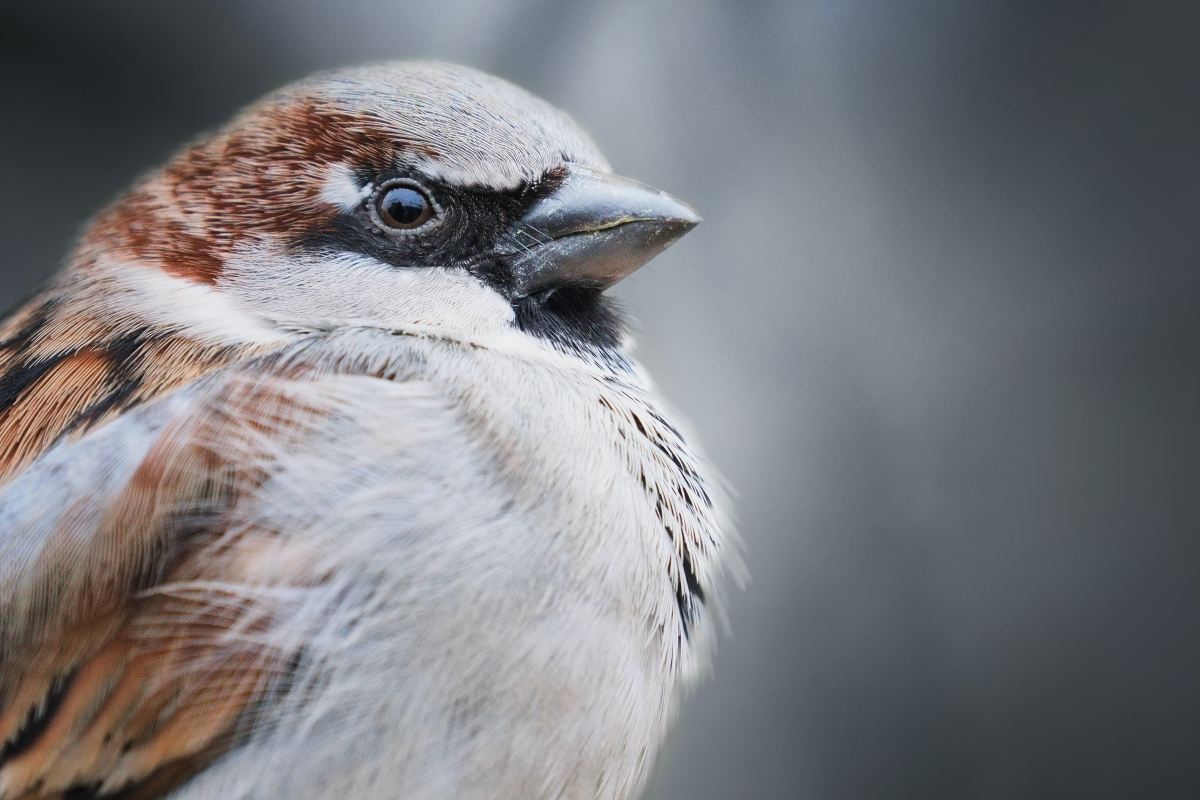
In 2016, my partner and I moved into our new home in Centennial. As any birder would, I immediately started keeping a yard list. My early efforts were modest, as there was just too much to do inside the house. A Dark-eyed Junco and Spotted Towhee appeared on my first yard checklist. My second records that American Crows chased a Cooper’s Hawk into my yard. A pair of Eurasian Collared Doves, the most common introduced species in my yard, were probably none too happy with that.
House Sparrows soon followed. My eBird records tell me I first spotted spotted one in my yard on March 20, 2016. A pair in early April. The species was common then, and they’d stay so through 2017.
And then, something changed. I submitted no checklists with a House Sparrow in 2018, just three in 2019, none in 2020, a single one in 2021, and none in 2022 or 2023.
I’m not the most rigorous backyard birder. So it’s possible I’ve missed a House Sparrow over the years. And other common suburban birds — Black-capped Chicakdees and House Finches, most notably — remain constants.
Success, right? We’re meant to “manage” introduced species like House Sparrows and Eurasian Starlings around our yards and nest boxes. Certainly, I was trying. I removed the dank nesting boxes, which some previous homeowner had put up, once I noticed House Sparrows investigating them. I removed a Forsythia shrub, a European and Asian plant whose tangle of branches House Sparrows seem to enjoy.
But a funny thing happened once the House Sparrows disappeared. I starting missing them, a taboo emotion, I know, for an invasive species.
I also got a little worried. House Sparrows hadn’t only gone missing from my yard. I struggled to find them around local open spaces and trails, despite living in a thoroughly suburbanized area.
Don’t get me wrong — I can still find a House Sparrow when I “need” one (as for a local Big Day). All I have to do is head to a shopping center. But the decline of House Sparrows may not be the victory for biodiversity that we had hoped it is. Rather, it may be a sign of broader species decline and loss.
If it is, it begs a question: how should we feel about this enduringly vilified bird?
House Sparrows and the Making of a “Junk” Bird
House Sparrows were introduced in the U.S. in the mid-1850s. Within fifty years, the bird owned the country.
In the early 1940s, House Sparrows outnumbered people in the U.S., peaking at an estimated 150,000,000 birds.
Being ultra-common has done House Sparrows no favors. At our worst, birders call them “trash birds.” Even among the most generous among us, I suspect there’s a sense that the species is hardly worth the trouble of counting. (Ask yourself: when’s the last time you described an encounter with a House Sparrow as the highlight of an outing? Ever?)
Certainly, House Sparrows don’t seem be trying to get us to like them. They’re drab, a combination of brown and gray and black. Even their cleanest portions appear dusty. They forage in dirty corners of city streets, the better to find whatever crumbs we’ve neglected.
Worse, the bird wreaks havoc on our native birds. Here is Peyton Marshal, in the New York Times.
Ever since my mother joined the North American Bluebird Society, or NABS, she’s had it out for the English house sparrow — a bird that, when it isn’t devouring butterflies and yellow flowers, is pecking out the brains of bluebird mothers, dumping their lifeless bodies in the grass and then throwing their children out to die.
These are old sentiments.
In “Dirty Birds, Filthy Immigrants, and the English Sparrow War,” sociologists Gary Alan Fine and Lazaros Christoforides document how ornithologists and others of the late-19th century used anti-immigrant rhetoric to turn public attention against House Sparrows.
Here in Denver, W.H. Bergtold, one of the city’s first ornithologists, cheered on the decline of House Sparrows in the early-1900s. Cars, having replaced horses, meant city streets lacked food for the bird (horse droppings). In his 1921 article in The Auk on the bird and automobiles, Bergtold barely contains his hope that cars would make the House Sparrows existence so
“hazardous and fatal as to drive it largely out of the business areas.”
The Decline of House Sparrows
But then. Then we realized that U.S. House Sparrows are on the decline too. Birds of North America a decrease of about 2.6% per year since the late 1960s. One recent study by the Cornell Lab of Ornithology used FeederWatch data to assess the species’ population between 1996 and 2016. While they found no declines in rural areas, they declines in both the proportion of FeederWatch sites reporting the species and the overall size of House Sparrow flocks.
The story in Denver and its suburbs may be even more stark. Christmas Bird Count data tells a story of precipitous decline. Until 2010, Denver’s CBC participants regularly tallied 1,300 – 2,400 House Sparrows. Since then, we haven’t cleared a 1,000. And the lows are startling. Fewer than 2000 House Sparrows were counted in 2016, 2019, and 2021, when a count low of 119 were recorded.
Why the decline? Birds of North America lists changes in farming practices. Changes in efficiency — fewer spilled seeds, fewer weeds — leave less food behind. Changes in crop spraying and pesticides does too. Whether this would explain declines in urban and suburban birds — and if these populations are declining indeed — is unclear.
And this brings me to the question central to this entry: how should U.S. birders feel about the decline of House Sparrows? The insta-response is to celebrate. Here is an unwanted bird finally ceding back some of its territory.
If it were as simple as native birds and us winning together, us using “sparrow-proof” boxes and feeders, establishing native landscapes unappealing to House Sparrows, and those native birds moving back in, I might share this response.
But as House Sparrows decline, they often leave empty ground. Bird numbers are on the decline across the country, across habitats. Who fills their niche?
Fellow Travelers
Consider, for instance, a fellow traveler of House Sparrows, the native House Finch. The birds use similar nesting boxes. As Bergtold documented the early-20th century decline of House Sparrows, he rejoiced
In previous years the writer spent a good deal of his spare time, when at home, in protecting his House Finches from the ravages of the English Sparrow, but it has not been at all necessary during the past three years. This relief from sparrow depredations, it would seem, has not been due to increased protection, but rather to the absence of sparrows; the fact is there have been fewer sparrows to harass the finches.
No such good fortune today. In the U.S., House Finches have experienced a decline similar to that of House Sparrows, of about 3.3% annually.
In Europe, House Sparrows are a conservation issue. Could it be that, one day, U.S. birders will be like their European counterparts, rooting for a yard sighting of the uncommon House Sparrows?
But ought we embrace the House Sparrow sooner than that, realizing that their decline is sign of a wounded environment? Might we rejoice, then, at one feeding alongside our invited visitors? Might we celebrate the bird when it succeeds, nestlings raised to adults, as a symbol of the natural world not yet done in?
Bergtold thought that to save the House Finch, we had to sacrifice the House Sparrow. Today, it may be otherwise. We may need to learn to accept House Sparrows, even save House Sparrows, if we are to also save House Finches.
Featured Photo by Łukasz Rawa on Unsplash


Leave a Reply