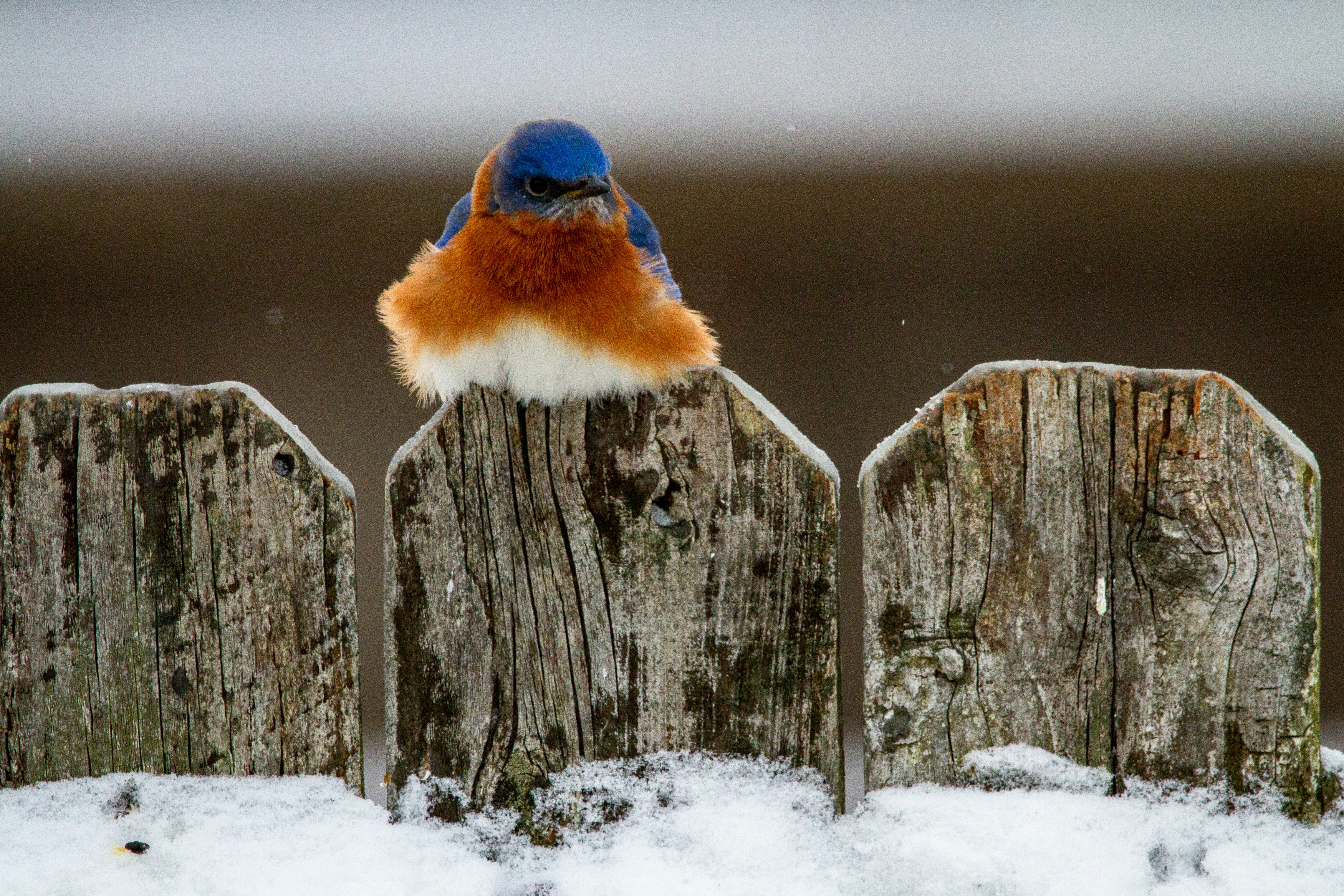
Once, eastern U.S. communities anxiously awaited the return of Whip-poor-wills–for the call of the first was said to signal the end of frosts. But another species was an even earlier sign of spring: Eastern Bluebirds (Sialia sialis).
In his journal, Henry David Thoreau documents how important Bluebirds were as season signs. Having famously written that the species “carries the sky on his back,” I think it’s also safe to say that for those of us worn out by winter, they also carry hope. Here is Thoreau’s March 7, 1859, entry on the bird.
March 7, 1859. There are few, if any, so coarse and insensible that they are not interested to hear that the bluebird has come. The Irish laborer has learned to distinguish him and report his arrival. It is a part of the news of the season to the lawyer in his office and the mechanic in his shop, as well as to the farmer.
One will remember, perchance, to tell you that he saw one a week ago in the next town or county. Citizens just come into the country to live put up a bluebird box, and record in some kind of journal the date of the first arrival observed, though it may be rather a late one. The farmer can tell you when he saw the first one, if you ask him within a week.
From Thoreau’s Bird-Lore, edited by Francis H. Allen (1925)
The Prophesies of Bluebirds in a Changing Climate
What’s most remarkable to me is how much of social life seems activated by first birds. The first Whip-poor-will was breaking news for signaling an end to frost. Bluebirds seemed a more general sign, a prophesy.
This, at least, is what the poet Henry Wadsworth Longfellow saw in the birds.
The sun is bright,–the air is clear,
Longfellow, “It Is Not Always May” (1842)
The darting swallows soar and sing.
And from the stately elms I hear
The bluebird prophesying Spring.
But what, exactly, do Bluebirds prophesize? Thoreau heard them as early as February, on one warm winter day. So perhaps they might have been a sign of “false springs” even then. (I have a slightly different experience in Colorado; I always see my first flocks of the year amid weird spring snows that draw migrating birds to warm, food sources.)

CC BY-SA 2.0 DEED
But today, they’re by no means uncommon in the winter, including in Henry’s Massachusetts.
It’s possible Bluebirds now stick around through winter because winter is milder — a bit more spring-like — owing to climate change. Perhaps landscape practices have also help, with every house and town packing in berrying shrubs and vines that can sustain thrushes in the winter.
In Concord, Massachusetts, Bluebirds weren’t regularly observed during Christmas Bird Counts until 1991. In the greater Boston area, it was even later: 2001. All this suggests something is happening. Bluebirds are changing their minds about the seasons. Or else the seasons are changing, probably with our “help.”
So what should you think if you see Bluebirds on a late winter or early spring day? Should you ditch the mittens and boots? Probably not.
I’d recommend you just attend to the birds. What are they doing? What are they feeding on? And what does this tell us about their lives in these landscapes amid this climate?
After all, I suspect Thoreau would not have been so dogmatic as to take the birds for an eternal sign of spring — had he known what was to become of our world.
Credits
Featured Photo by Joshua J. Cotten


Leave a Reply