Though most of us no longer heard it this way, Whip-poor-will’s name is a sentence, a complete thought: “Whip poor will.” As in, administer a whipping to an unfortunate or impoverished person named Will.
As I noted in my previous post on this sentence, it wasn’t inevitable that we should start calling these birds-who-sing-their-name by the name they sing — and by this particular name: “Whip poor will.” Sure, the song sounds enough like that. But it also sounds like “Whippoo-will,” as we once called the bird, and “Whipperiwhip,” as the Finish naturalist, Pehr Kalm, described the bird’s song.
But the sentence was compelling, at least in part, because whipping, as a form of punishment, had long been a taken-for-granted feature of English (and, so, colonial) life.
Whip-poor-will: The Consequences of a Name
This naming had consequences, and this blog post is about one of those consequences: Poets, musicians, and educators incorporated the Whip-poor-will’s names into lessons, particularly those for children. The bird became, in other words, part and parcel of America’s morality tales. To encounter it was not just to encounter the bird — a remarkable encounter, indeed — but to also encounter the country’s sense of propriety, justice, and punishment.
This is most fully realized in George Pope Morris’s poem, from the 1840s, The Whip-poor-will. But before I get to Morris’s lyric, a few other references, just to demonstrate that whipping Will was a rather pervasive way of evoking the bird. I’m sharing two that come from educational materials for children, since these suggest that some of the earliest knowledge Americans would have with the bird would be caught up with whipping.
The first image comes from a music book, Progressive Music (1875), intended for use in public schools.

The second image comes from a book, The See and Say Series (1914), which appears to be something like a reading workbook for children.

The Morality of Whip-poor-wills
It’s George Pope Morris’s poem, The Whip-poor-will, that got me thinking about the relationships between 19th and early 20th century understandings of Whip-poor-wills, punishments, and the moral order.
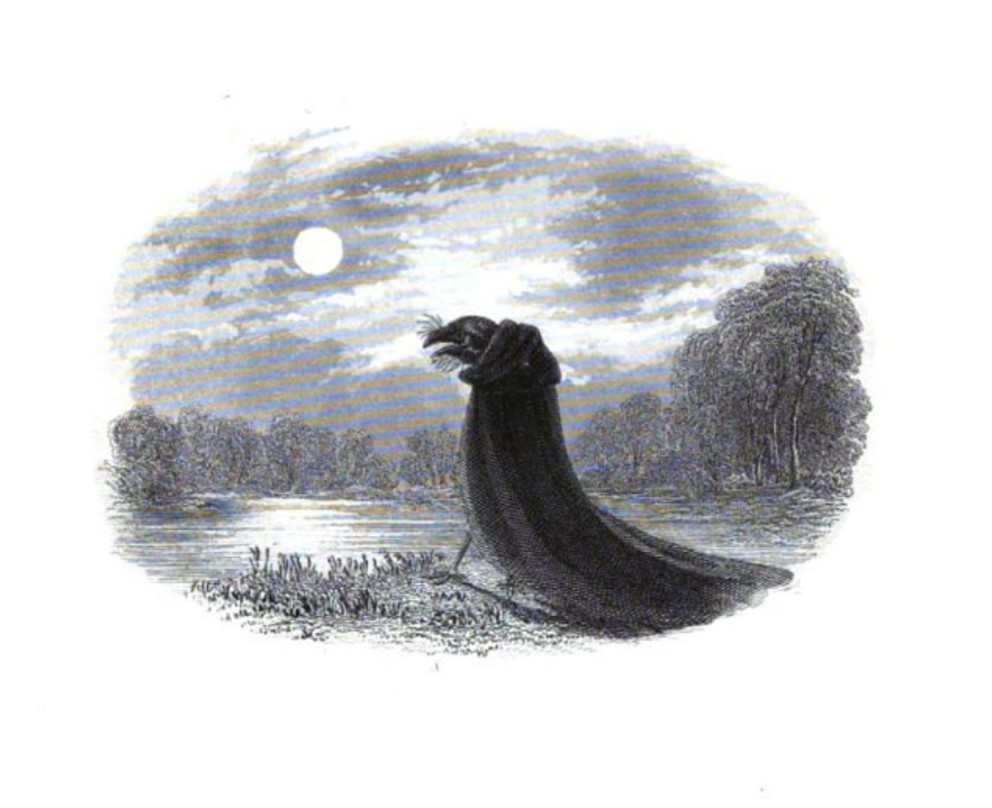
Partly, it’s because of the lol quality of the engravings that appeared with an 1846 edition of Morris’s poem. The image that opens this blog might be my favorite of a Nightjar. Here he is, standing like a human (the Will, of course), and cloaked. The image illustrates this brutal verse:
Still “Whip poor Will!”–Art thou a sprite,
From unknown regions sent
To wander in the gloom of night,
And ask for punishment?
I met Morris (a week ago or so) with this poem, so what I’m about to say about the man comes straight from Wikipedia: he was an influential newspaper editor, a writer of popular song, and apparently admired by Edgar Allen Poe (for those songs).
The poem explores the cause of Will’s whipping. Perhaps it’s poverty (the “poor” in Whip-poor-will)? In his verse raising this possibility, Morris demands that joy itself be driven from Will’s heart.
If poverty’s his crime, let mirth
From his heart be driven:
That is the deadliest sin on earth,
And never is forgiven!
The poem continues on like this, exploring the reasons a bird might demand that Will — or is the bird condemning himself, Morris wonders — be whipped. Morris wanders through Will’s failures in love and friendship and the self-guilt that might lead a Whip-poor-will to demand punishment.
Morris concludes the poem by universalizing the whipping (lovely). The message seems to be this: We’re misunderstand the Whip-poor-will if we think the bird sings to demand only that Poor Will be whipping. Rather, the Whip-poor-will sings so that all of us should know we deserve punishment, unless we repent.
But use thee kindly–for my nerves,
Like thine, have penance done:
“Use every man as he deserves,
Who shall ‘scape whipping?”–None!Farewell, poor Will!–Not valueless
This lesson by thee given:
“Keep thine own counsel, and confess
Thyself alone to Heaven!”
What We See in the Birds
Of course, the Whip-poor-will does not sing “Whip-poor-will,” no matter how many times we emphasize that the bird emphatically chants his name. Nor do Whip-poor-wills exist to teach us lessons about poverty, morality, and justice.
And yet we’ve believed they do. This, perhaps, is the only true lesson of Whip-poor-will’s name: We see in this bird, and in so many other non-human species, what we see in ourselves.
This is the second of two posts about the Whip-poor-will’s name. You can find the first here.



Leave a Reply