|

|
Whip-poor-wills have only been reported as far north as Tallahassee, Florida, where they overwinter. Here in Colorado, Bitterroot (Lewisia rediviva) has sent leaves--as tiny as they are brave--into my now snow-covered yard. Spring is far, but it's a new year!
|
In this email
- New year, new bird: a rarity on Denver's Christmas Bird Count
- The goose who stayed: my recent essay on our love-hate relationship with Canada Geese
- Upcoming talks
New year, new bird 🦆
|
For me, 2025 began earlier than it ought to have: On the first, I woke before my alarm, which itself intended to wake at 4:30 AM. Why that early of a start? Owls. Denver Audubon holds its annual Christman Bird Count on 1/1, so I spent the last few cold hours before the sun listening for Great Horned and Eastern Screech-Owls. Then, rendered sufficiently cold by a winter sunrise, I refueled with espresso and helped count day birds.
|
This year, I joined a small group of exceptional birders to count along one of my favorite suburban habitats: the High Line Canal Trail. We tallied a number of "good" (that's code for "uncommon") birds for the count: Brown Creepers, White-throated Sparrows, Hairy Woodpeckers, and Greater White-fronted Geese.
|
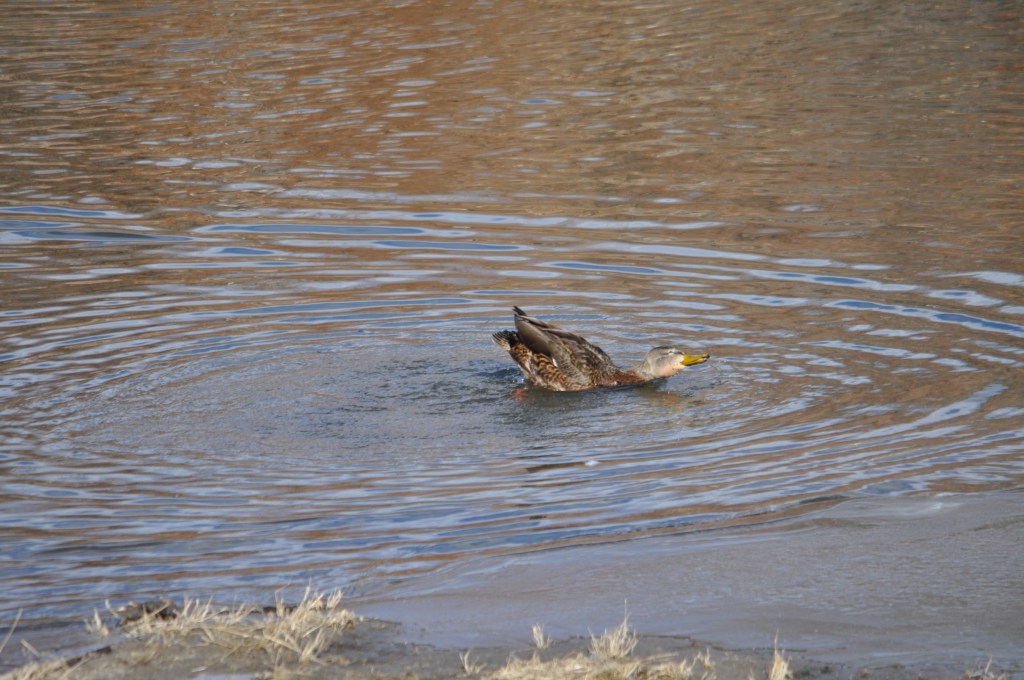
But the bird of the day was a duck that masquerades as an ultra-common one: a possible Mexican Duck in the Cherry Creek at a city-operated golf course. A more cooperative rare bird would be hard to find. To distinguish a Mexican Duck from a Mallard, you need all sorts of views of feathers. This one preened in the creek, somersaulted, and flashed its wings for our photoshoot.
|
|
Whether a true Mexican Duck or a bit of a hybrid with a Mallard, the encounter mixed the birder's thrill of discovery with the challenge of identification with the joy of a bird who seemed joyous. (You can read my recount of the count here.)
|
|

|
|
|
The life & times of a lunaphiles 🌕
Whip-poor-wills are a lunaphilic species, syncing much of their life to the full--and nearly full--moon.
|
Perhaps we might, too. The first full moon of 2025 is January 13. Coincidentally, my first talk on Whip-poor-wills is the day after. You can read more about it and register here.
|
The goose who stayed 🪿
For a little while in 1989 or 1990, a Canada Goose lived with my family and me in the Hudson Valley of New York. I wrote about that experience, as well as the love-hate relationship many people have to geese, in my first essay for Denver Field Ornithologist's new quarterly version of its Lark Bunting.
|
Upcoming! 🗓️
I have a trio of upcoming talks on nightjars and culture. All are free, open to the public, and online.
|
|
January 14 (8:00 PM MST) - University of Denver's Enrichment Program. Register here.
|
|
February 20 (7:00 PM MST) - Colorado Field Ornithologists. Register here.
|
March 10 (7:00 PM EST) - Sarasota Audubon. Note: time Eastern. More here.
|
Registration for the Sarasota Audubon event will be available soon.
|
|
Northeast Public Radio. Sometime this spring, you'll be able to hear my audio essay on Whip-poor-wills on Northeast Public Radio's program, The Academic Minute. I'll share the date and time when I have them!
|
|

|
|
The goose who stayed, for a time.
|
|
|
|
What I'm Listening To 🪕
There are a handful of nostalgic songs that mention Whip-poor-wills. They've kept me company as I've written about...well, nostalgia and Whip-poor-wills. To my ears, one of the best of those songs is Dolly Parton's "The Greatest Days of All."
|
|
Many nostalgic songs are just a bit too maudlin for me--the past is just a bit too sweet and pure, the present too far gone to be redeemed. Parton's song offers a more honest appraisal. The past can be the greatest days of all, difficulties and all. Plus, rarer than a Whip-poor-will in a country song, Parton invokes a dauber in the opening line.
|
Credit to Sarah Crowder, whose Whip-poor-will playlist for her essay, "American songwriters are obsessed with the Whip-poor-will," introduced me to this song.
|
|
|
|
|
Once more, that duck celebrating the new year.
|
|
|
|
|
|
|
"To sleep where you may hear the whip-poor-will in your dreams!"
- Henry David Thoreau, 1851
|
lonesomewhippoorwill.com
jared@lonesomewhippoorwill.com
|
|
|
|
|